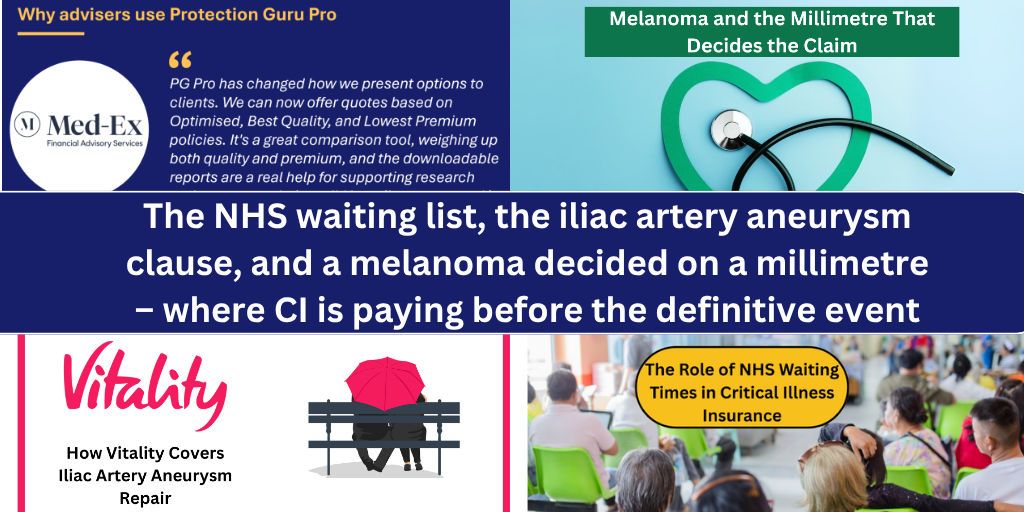
Last week’s articles on Protection Guru looked at three ways in which Critical Illness (CI) cover is designed to pay before the definitive clinical event has taken place. On the NHS waiting list rather than at the operation. On a pre-invasive diagnosis rather than at cancer that has broken through. On the specific vascular wording that sits next to abdominal aortic aneurysm on Vitality’s Serious Illness Cover. A fourth piece showed how Protection Guru Pro handles a term assurance comparison.
In How Vitality Covers Iliac Artery Aneurysm Repair, we get a specific example of the earlier trigger at work. Iliac artery aneurysms are close cousins of the more familiar abdominal aortic aneurysm, sitting a little lower in the pelvis where the aorta divides. The Vitality wording covers surgical repair by open or endovascular means, and pays either on the repair itself or on being placed on the NHS waiting list for it, whichever comes first. That distinction matters because waits for planned vascular surgery run into months, and the wording lets the payment reach the client while the operation is still ahead of them. Iliac and aortic aneurysms travel together in most patients, so the wording is not a rare oddity but part of the vascular set an adviser should know sits on the policy.
In Melanoma and the Millimetre That Decides the Claim, timed for UV Safety Awareness Month, the earlier trigger takes a different form. Melanoma has climbed steeply over the last three decades and causes most skin cancer deaths, but survival is strong and improving. Around 19,400 new cases are diagnosed in the UK each year, with around 2,600 deaths. The line that decides the CI outcome is the pathologist’s measurement of Breslow thickness, whether the melanoma has broken through the epidermis into deeper tissue. An invasive melanoma meets the standard cancer definition and pays in full. A melanoma in situ, where the cells have not yet crossed that line, does not. Most modern policies now pay for melanoma in situ as an additional payment, typically a smaller fixed sum or a percentage of the cover, without touching the main amount. The same diagnosis can produce a full claim, a partial one, or nothing at all, depending on a single line in the pathology report and the policy the client happens to hold.
In The Role of NHS Waiting Times in Critical Illness Insurance, we get the market-wide picture. The English waiting list peaked at around 7.8 million treatment pathways in September 2023 and had eased to around 7.2 million by early 2026, still well above the pre-pandemic level of 4.4 million. The 18-week constitutional standard has not been met since September 2015. Insurers have responded by adding waiting list clauses to major surgical wordings, so the payment can reach the client at the point of listing rather than at the point of operation. The article walks through the categories where this matters most: cardiac surgery, where median waits run to 114 days; major organ transplants, where routine kidney waits can run to two or three years; benign brain tumour and pituitary surgery, where only around 55% of neurosurgical patients are treated within 18 weeks; and vascular surgery, where only 31% of aortic aneurysm cases hit the NHS eight-week target. In each of these areas, the waiting list trigger closes a real gap between the point the client’s life is disrupted and the point cover would otherwise pay.
The final piece of the week, How to Run a Life Insurance Comparison with Protection Guru Pro, is a short demonstration of how Protection Guru Pro handles a term assurance comparison, using the Express route to filter out reviewable, low-start and optimiser products, then reading quality scores against price. For any adviser writing life cover regularly, it is worth ten minutes.
There is a thread across all four pieces. Modern CI cover is not only about the moment of a serious diagnosis or the day of a major operation. It is increasingly about the months before, when the client is on the list, or the pathology is on the borderline, or the vascular problem is one of several. The adviser’s task at recommendation is to know which policies pay at those earlier moments. Fortunately, Protection Guru Pro is built exactly to surface that detail.
We produce our Protection Guru Digital Directory as the ultimate protection technical guide for advisers, tying every awareness day and clinical condition back to the policy realities.
Do you want to present your clients with a thorough analysis that shows them the cheapest plan, the most comprehensive cover and something in the middle that may offer the best value, with a condition-by-condition breakdown? If so, you may want to upgrade your protection proposition to Protection Guru Pro. Typically 85% of clients, given the choice between the cheapest plan and a better one, go for something better. After all, they are buying cover to protect the people they care about the most.
Advisers using our system regularly find they increase their written premiums, and therefore their commission, by 20% per month. If that sounds worthwhile, next time you need to give protection advice please click the button below to get a 7-day free trial of Protection Guru Pro. Please wait until you have a case you want to test our system with.
If you are part of a firm with 10 or more advisers, please complete our Corporate Licence Enquiry Form so we can explain how we can grow your protection income and tell you more about our Enterprise arrangements for larger firms.