Welcome to 2026! I hope you had a great rest over the Christmas period and are raring to go in 2026. This is going to be a fascinating year for Protection Guru and I will have lots of exciting things to tell you about over the coming months. Today I would like to hit the ground running with thoughts on how the awareness days promoted by Charities can be a great way to create content that can lead to informed client conversations.
Clients rarely want to talk about Critical Illness insurance. What they do want to talk about is their health, their family, and the things they worry about but do not always say out loud. Health awareness days give advisers a simple, natural way to start those conversations without leading with a product. They create permission to talk about real conditions, real risks, and real life, before insurance ever enters the room. When done well, the protection conversation feels less like a sale and more like a sensible response to something the client already cares about.
That is exactly why, across 2025, we have used national and international health awareness days as the starting point for a structured series of practical, adviser-focused insights, bringing together medical reality and how Critical Illness and Income Protection policies actually respond.
Health awareness days 2025: the complete Protection Guru guide for advisers
Health awareness days can look like fluffy calendar noise if you are busy, client-facing, and trying to get protection recommendations over the line. But they are actually one of the easiest ways to have better, more human conversations about risk.
They work because they give you a reason to talk about something difficult without making it feel like a sales pitch. They also give clients permission to ask questions they have been sitting on for years. “My dad had bowel cancer.” “My partner has endometriosis.” “I’ve had palpitations since Covid.” “I’m drinking too much.” These are the real moments where protection advice becomes real.
That is why we built our awareness event series.
Across 2025, we worked with our panel of doctors and medical experts to unpack conditions in plain English and then translate that into what matters for advisers. What the condition actually is. Who is more likely to suffer from it. How it is diagnosed and treated today. How Critical Illness (CI) cover responds in practice. Where Income Protection (IP) fits better. Where definitions have evolved. Where wording still creates uncertainty. And where insurer added value benefits can support prevention and earlier intervention.
If you are not medically trained, you are not alone. Most advisers are not. And yet clients often expect you to explain complex conditions and policy definitions with confidence, at the exact moment they are anxious and overloaded. These articles are written to help you bridge that gap, without pretending you are a clinician, and without falling into the trap of over-promising what insurance will do.
This page is the hub. It links to the four quarterly round-ups so you can dip into whatever is relevant. You can also use it as a quick bookmark for CPD, team discussions, or planning your client communications calendar.
January to March: prevention, definitions, and the real world gaps in cover
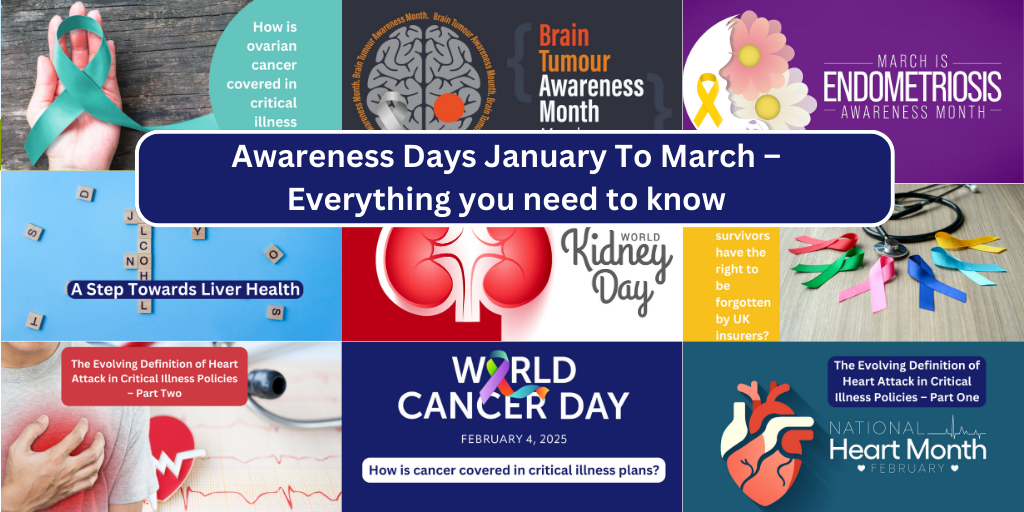
The first quarter set the tone. It covered lifestyle-driven risk, the reality of chronic conditions, and how much modern diagnosis has changed what “counts” in policy terms.
Dry January was the obvious place to start. Liver health is one of those areas where lifestyle, disclosure, and exclusions collide. It is also a reminder that small habit changes now can prevent very big problems later.
Children’s Mental Health Week took us into the practical value of insurer support services for families. Advisers often talk about added value benefits as a nice extra. In reality, for many clients, these services are the most immediately useful part of the proposition.
World Cancer Day did what it should. It forced us to explain staging, metastasis and pre-cancerous conditions properly, and then map that to how CI policies actually pay. It is not enough to say “cancer is covered”. Advisers need to understand what sits behind that sentence.
National Heart Month then tackled a core industry problem. Heart attack definitions have had to evolve with troponin testing and imaging. That is good for clinical care, but it can create confusion if wording does not keep up.
March also gave us two important “system” articles. One on endometriosis, which is a perfect example of a condition that can be life-changing and work-destroying, but sits awkwardly against traditional policy structures. The other on kidney disease, which is well covered in CI once it is severe, but where prevention and support services matter enormously.
And then there were the debates. Vaping and smoker status, where underwriting practice lags evidence because insurers are cautious. And the right to be forgotten for cancer survivors, which is a fairness question the UK will have to face sooner or later.
You can read the full January to March round-up here:
Awareness Days January to March: Everything You Need To Know
April to June: practical condition explainers advisers can use immediately
Quarter two was about confidence in the room. Conditions clients recognise. Conditions that come up in claims. And the day-to-day challenge of explaining what a definition really means.
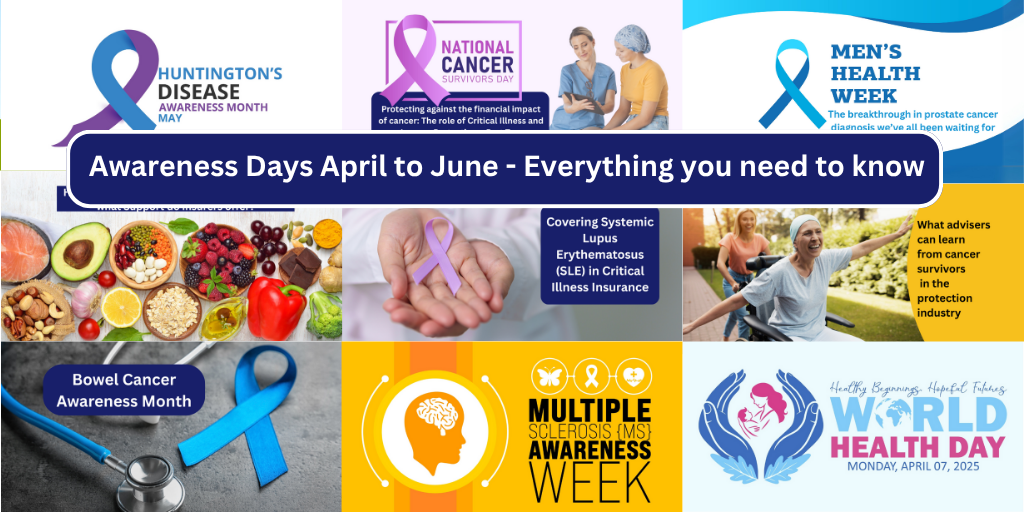
We covered bowel cancer, Parkinson’s disease and multiple sclerosis. We ran a three-part deep dive into Huntington’s disease because genetics, testing, and insurance decisions are not a one-paragraph topic. We also looked at lupus, dementia, type 2 diabetes prevention, and the very human side of cancer, including the impact on work and life, not just the medical label.
We also made sure the quarter included practical wellbeing angles, like nutrition and lifestyle support, because prevention and better health habits are part of good advice, even when the product is an insurance contract.
You can read the full April to June round-up here:
July to September: the quarter where mental health, rare conditions, and claims reality met
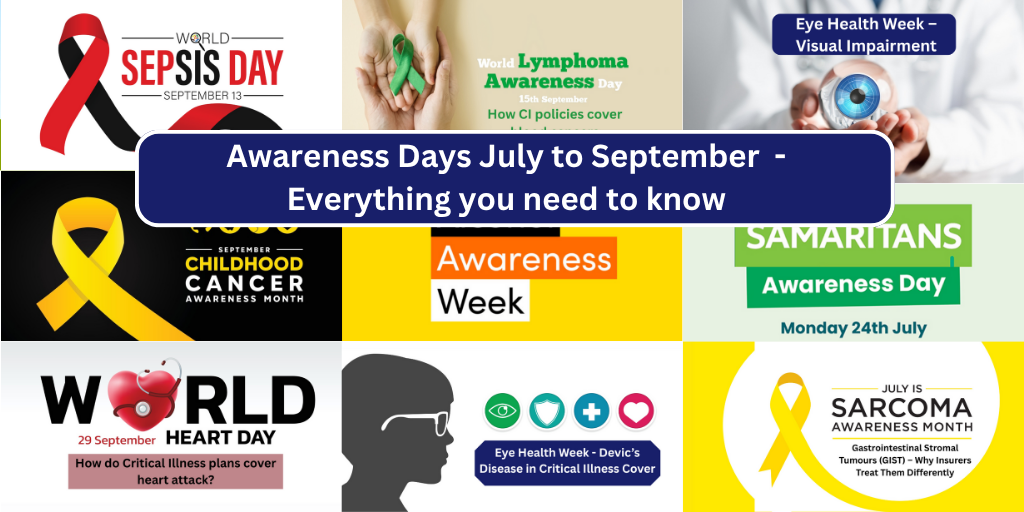
Quarter three widened the lens. It included rare cancers like sarcoma and more specialist topics like gastrointestinal stromal tumours (GIST). It also covered conditions that are widely misunderstood, like schizophrenia, and conditions that often sit in the background of client lives, like hepatitis.
It was also the quarter where we leaned harder into behavioural health and wellbeing. Alcohol, self-care, brain health. The sort of topics that advisers often avoid because they feel personal. But they are the topics that often sit behind risk, claims and long-term work absence.
September was especially dense. Sepsis, Alzheimer’s, lymphoma, eye health and a multi-part series on serious eye-related CI wordings. Childhood cancer and family impact. Heart attack cover again in the context of World Heart Day. It is exactly the sort of content advisers can use to sharpen their understanding of what policies do and do not cover.
You can read the full July to September round-up here:
Awareness Days July to September: Everything You Need To Know
October to December: definitions, underwriting, and the client conversations that really matter
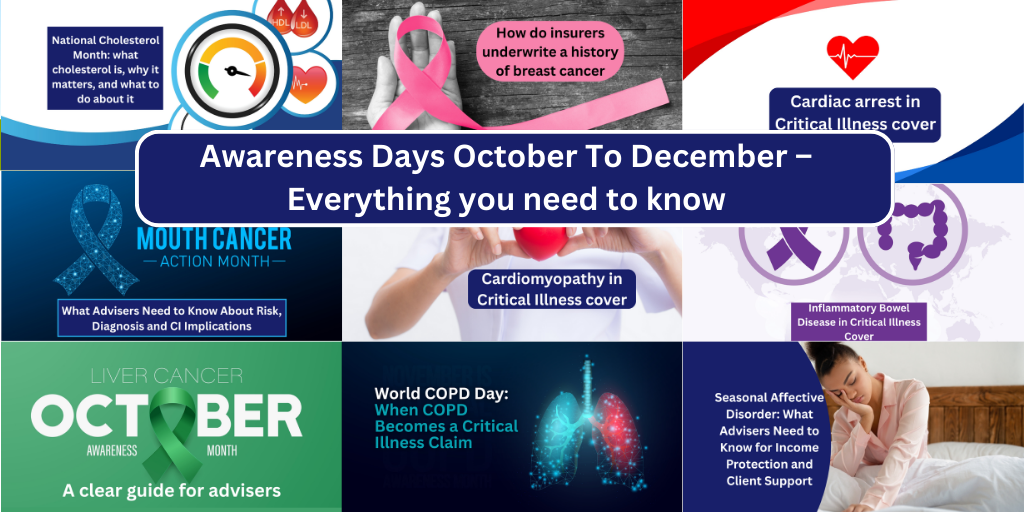
Quarter four tied together many of the themes we see repeatedly in claims and underwriting. Cardiovascular disease featured heavily, with National Cholesterol Month acting as the anchor. We also ran a structured set of explainers that made it easier to compare how insurers treat common cardiovascular-related CI triggers.
Mental health came into sharp focus again, but this time through a practical question. Are we actually recommending the right product when mental health is the risk? The honest answer is that IP often matters most, yet it still gets under-sold.
We also covered cancer underwriting and screening, menopause, pneumonia and when it becomes a CI event, diabetes definitions, chronic obstructive pulmonary disease (COPD), prostate cancer and men’s health, pancreatic cancer, mouth cancer, grief, inflammatory bowel disease, and seasonal affective disorder.
It was a quarter full of topics that advisers can use to improve how they explain protection. Not just what it pays, but why it matters, how clients experience illness, and where good advice changes outcomes.
You can read the full October to December round-up here:
Awareness Days October to December: Everything You Need To Know
The simplest way to use this series
If you only do one thing, use awareness days as permission to check in with the clients who are most exposed to the risks you are talking about.
That might mean the clients with no IP who have families and depend on salary. It might mean the older clients who took CI ten years ago and assume it is identical to what exists now. It might mean the female clients whose health risks are under discussed. It might mean the clients who are “fine” but clearly not sleeping, not coping, drinking more than they should, and trying to hold everything together.
These articles are not a marketing exercise. They are tools. They are there to help you have better conversations, set clearer expectations, and make recommendations that stand up when life gets messy.