Most clients don’t understand protection as well as they think. How we change that was a recurring theme of last week’s articles. They showed repeatedly why advisers who rely on surface level explanations risk leaving people exposed, and how to do better.
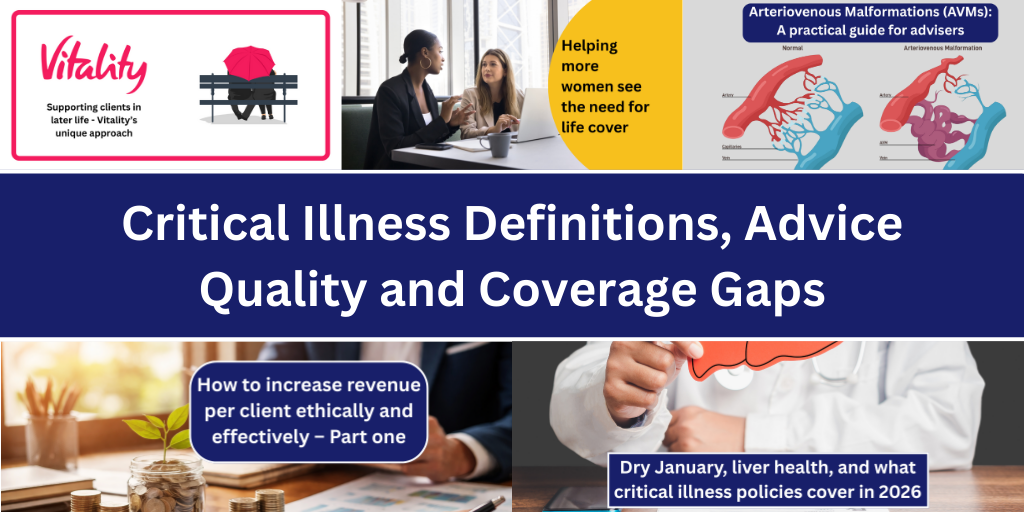
We started with a sharp reality check linked to Dry January and liver health. In Dry January, liver health, and what critical illness policies cover in 2026, the article cut through a dangerous assumption. Liver disease does not usually equal a Critical Illness (CI) claim. Most policies only pay once liver failure has reached an advanced, decompensated stage, typically with complications such as ascites, permanent jaundice or hepatic encephalopathy. Significant scarring, fatty liver and long periods of ill health often still fall short of policy definitions. The article also explored why alcohol history, metabolic health and disclosure can become decisive at claims stage, particularly where alcohol exclusions apply. With alcohol related deaths at record levels and metabolic liver disease rising quietly, this is an area where advisers need to be confident, precise and honest.
That same gap between medical reality and policy wording came up again in Arteriovenous malformations (AVMs): a practical guide for advisers. AVMs are rare, but they expose a major weakness in some CI definitions. Modern NHS treatment often involves endovascular embolisation, stereotactic radiosurgery or staged combinations, not just open surgery. Policies that only recognise craniotomy materially reduce real world payability. The article explained how AVMs are actually treated and why broader, treatment aligned definitions are far more likely to lead to fair claims outcomes. It was a reminder that advisers do not need to be clinicians, but they do need to understand how medicine is practised today, not how policy wordings assume it works.
Alongside claims and definitions, last week also tackled adviser behaviour and business outcomes head on. In How to increase revenue per client ethically and effectively – part one, Terry Blackburn delivered a key message. Higher revenue does not come from selling harder. It comes from advising better. Leading with value rather than price, presenting full protection solutions rather than minimum cover, asking better questions and involving all decision makers naturally increases case size. Tools like Protection Guru Pro were positioned not as sales aids, but as evidence tools that help advisers demonstrate quality, suitability and fair value under Consumer Duty. Better advice and better business outcomes were shown to be the same thing, not a trade-off.
On Wednesday Amanda Newman Smith addressed one of the industry’s most persistent protection gaps in Helping more women see the need for life cover. Despite their financial and practical contribution to households, women remain significantly underinsured. Secondary earners, carers and homemakers are still too often overlooked, even though losing them would fundamentally change a family’s ability to cope. The article also explored why women’s health journeys can complicate underwriting, from screenings to ongoing investigations, and why advisers need to frame protection around value to the household, not just salary. When that conversation is handled well, attitudes shift quickly.
Finally, attention turned to later life planning in Supporting clients later in life: Vitality’s unique approach. With dementia prevalence rising and care costs becoming unaffordable for many families, the article explored how Vitality’s Dementia and FrailCare cover allows Serious Illness Cover to remain relevant long after traditional retirement ages. The worked example showed how cover can adapt over time without further underwriting, providing funding when the risk of needing care is actually highest. It also raised a wider challenge for advisers. Are we spending enough time helping clients plan for the conditions they are statistically most likely to face later in life?
Taken together, last week’s articles shared a common warning. Assumptions are expensive. Whether it is CI definitions, life cover for women, adviser pricing strategies or planning for later life care, the biggest risks sit in the gaps between what clients think is covered and what actually is.
Wishing everyone a great week ahead!