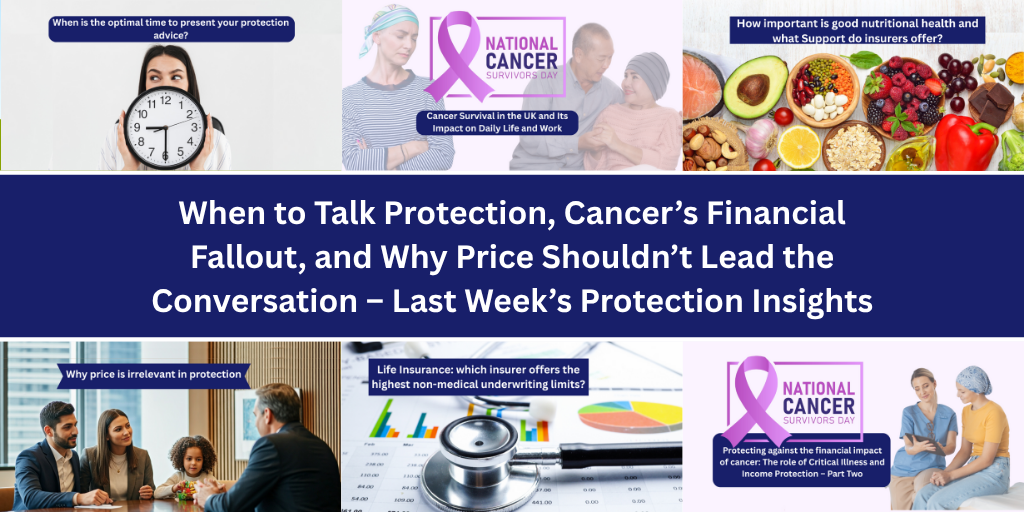
Last week we tackled some of the most practical – and emotive – challenges you’ll face when helping clients protect their future. From cancer’s long shadow over work and income to the right timing for protection conversations, our articles last week offer a toolkit of insights for advisers serious about better outcomes.
Before we dive in, here’s everything we published:
Monday
When is the optimal time to present your protection advice?
Tuesday
Cancer Survival in the UK and Its Impact on Daily Life and Work – Part One
How important is good nutritional health and what Support do insurers offer?
Thursday
Why price is irrelevant in protection
Life Insurance: Which Insurer Offers the Highest Non-Medical Underwriting Limits?
Let’s look at what stood out.
Start with the moment of trust, not the end of the process
Gary Waters reminded us why the mortgage submission stage is often the best moment to raise protection – not completion, and sometimes not even the offer letter. Clients are engaged, excited, and looking to you as the expert who made the deal happen. That’s when protection resonates most. Wait too long, and it can feel like an afterthought.
Cancer protection must go beyond the diagnosis
Following last week’s Part One on the lived reality of cancer and work, Part Two focused on how CI and IP help prevent financial collapse in the face of serious illness. A single lump sum may be enough for some – but advisers need to consider the longer recovery paths and mental health challenges where IP makes a crucial difference. The two products should rarely be viewed in isolation.
Consumer Duty: The bar is higher than “good value”
Jason Coleman’s look at CI advice under the FCA Consumer Duty reminds us: comparing products on quality and price alone simply isn’t enough. Advisers need to avoid foreseeable harm, and that includes poor understanding. Tools like Protection Guru Pro can help bridge the gap between adviser expertise and client clarity – not just in recommendations, but in documentation.
Don’t ignore nutrition – it could be what keeps a claim from happening
We know that a poor diet contributes to many of the conditions protection policies cover. Last week’s analysis of nutritional support services offered by insurers made clear just how underappreciated these benefits are. Advisers can play a vital role by not just selling cover but supporting prevention through the added value services clients often don’t realise they have.
Forget cheap. Focus on value
Martin O’Connell didn’t pull punches in his column last week. If your client doesn’t understand the risk, no price will feel worth paying. If they do, then price becomes almost irrelevant. His step-by-step conversation around cancer – what happens if you can’t work, how do you manage the kids, can you afford time off – was a masterclass in emotional engagement. And a timely reminder: real advice builds value first.
Medical evidence matters – but some insurers make it easier
Jason Coleman’s deep dive into non-medical underwriting limits is one to bookmark. Whether your client needs cover fast, has medical anxiety, or you just want a smoother process, knowing who asks for what (and when) can make all the difference. We’ll be revisiting this one again soon – expect a follow-up that simplifies the comparisons to focus on just a few standout insurers.
If you’re trying to sharpen your protection conversations, reduce NTUs, or better align your advice with Consumer Duty, last week’s articles give you a dozen ways to do just that. Any one of them could change the way you approach your next client case.
Have a great week everyone!