What are the key things that determine if a claim will get paid. That was our focus across Protection Guru last week, and it is why taking the time to read the pieces below will benefit you and your clients.
If you give Critical Illness or Income Protection advice regularly, last week’s articles on identify messages advisers can take straight into client conversations.
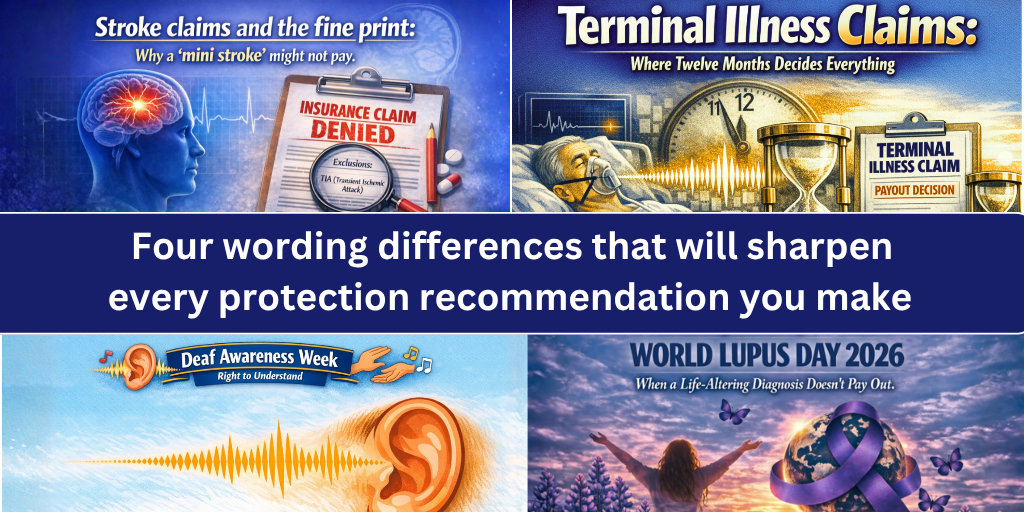
Stroke claims and the fine print: why a “mini stroke” might not pay is the cleanest place to start. Stroke is the third most common cause of CI claims, behind cancer and heart attack, and roughly 8 to 10% of payouts. Two stipulations decide whether a claim lands. The first is how long the symptoms must have lasted. Guardian’s wording asks for clinical symptoms that have lasted at least 24 hours, which is the threshold at which a stroke can be diagnosed at all. Other insurers require “permanent neurological deficit and persisting clinical symptoms”, which leaves a real question over what “permanent” means when around 10% of stroke survivors have no symptoms at three months. The second stipulation is whether the stroke must be confirmed on a brain scan. Some minor strokes, particularly in the back of the brain, do not show on CT or MRI. Where the policy requires scan confirmation, the chance of a successful claim is reduced. Two phrases on the page, two different outcomes for the same client.
Lupus: When a Life-Altering Diagnosis Doesn’t Pay Out carries the same lesson into a less familiar condition. The standard market wording pays out only where lupus causes either permanent neurological deficit or kidney function below an eGFR of 30. A diagnosis on its own is not enough. Joint pain, fatigue, skin disease and brain fog can be disabling in real terms and still fall short of the CI bar. Guardian adds a functional impairment uplift that pays when lupus, or another connective tissue disease, leaves a client unable to perform one of eight listed daily activities. Vitality’s Serious Illness Cover runs a severity model that pays 10% on diagnosis and steps up to 100% as functional impairment progresses. For a client whose lupus is progressive rather than sudden, those are the structures that can change the outcome. Worth noting too is that lupus is heavily skewed by sex and ethnicity. Around 90% of those affected are women, and Black Caribbean women in the UK have the highest incidence at around 31 per 100,000, against around 7 per 100,000 in White women.
Terminal Illness Claims: Where Twelve Months Decides Everything takes the same idea to the most consequential test of all. Terminal illness cover is bundled into nearly every term assurance contract in the UK and is the least understood part of protection for clients and for advisers. The ABI standard wording asks for a reasonable medical opinion that life expectancy is under twelve months and that no curative treatment is available. The word “expected” is doing a lot of work – the bar is lower than it often gets communicated at claim. Where claims stall, it tends to be because the consultant will not commit to a prognosis under twelve months, or the diagnosis is clear but sits outside any named cancers, or a legacy policy’s final-year exclusion is biting. Guardian’s enhanced definition writes around the prognosis question altogether for a named set of conditions including incurable stage 4 cancer, motor neurone disease, Parkinson-plus syndromes and Creutzfeldt-Jakob disease. On those diagnoses, the client does not have to prove they are in their last year to get the benefit. The article also pulls out the FCA’s 2023 multi-firm review, which sharpened the regulatory expectation that legacy final-year exclusions should now be the exception rather than the rule.
When hearing is the job: why own-occupation cover matters more than you think asks the same question from the Income Protection side. The IP definition is the equivalent of the CI wording – it is where the policy decides whether your client is covered for what they actually do, or only for the loss of any paid work whatever. A commercial pilot who fails a Class 1 medical hearing test cannot fly, but can almost certainly do other paid work. Own-occupation pays. Suited or any-occupation may not. The article extends the logic past pilots into musicians, teachers, paramedics and barristers, each of whom relies on hearing in ways no back-pain example will capture. Vitality’s IP carries an activities-of-daily-living fallback at twelve months that gives a second route to benefit where own-occupation has not been available. There is also a practical accessibility point that often gets overlooked. Under the Equality Act 2010, insurers owe a duty of reasonable adjustment at application. For a deaf or hard-of-hearing client, that may mean a written-only medical history, a video relay service, or a BSL interpreter at a medical exam. Self-employed clients can sometimes extend their Access to Work interpreter provision to cover the appointment. Advisers who handle these applications well agree the adjustments with the underwriter before the form starts.
Across the four pieces, the central tension is the same. The product is not the claim. The wording is. That makes the adviser’s job at recommendation a wording decision as much as a price one, and it is where Protection Guru’s research is built to help.
A reminder that we produce our Protection Guru Digital Directory as the ultimate protection technical guide for advisers – every awareness day, every clinical condition, every campaign tied back to the policy realities.
Whether the conversation with your client is about stroke wording, the eGFR threshold inside a lupus claim, or the twelve-month line on a terminal illness benefit, the practical question is the same. Which Critical Illness plan do you put in front of your client, and on what evidence? If you have not yet seen how Protection Guru Pro handles a Critical Illness recommendation in practice, the Critical Illness – new policies demo is a useful starting point. It is the difference between selling cover and recommending the right one.
Do you want to present your clients with a thorough analysis that shows them the cheapest plan, the most comprehensive cover and something in the middle that may offer the best value, with a condition-by-condition breakdown? If so, you may want to upgrade your protection proposition to Protection Guru Pro. Typically 85% of clients, given the choice between the cheapest plan and a better one, go for something better. After all, they are buying cover to protect the people they care about the most.
Advisers using our system regularly find they increase their written premiums, and therefore their commission, by 20% per month. If that sounds worthwhile, next time you need to give protection advice please click the button below to get a 7-day free trial of Protection Guru Pro. Please wait until you have a case you want to test our system with.
If you are part of a firm with 10 or more advisers, please complete our Corporate Licence Enquiry Form so we can explain how we can grow your protection income and tell you more about our Enterprise arrangements for larger firms.