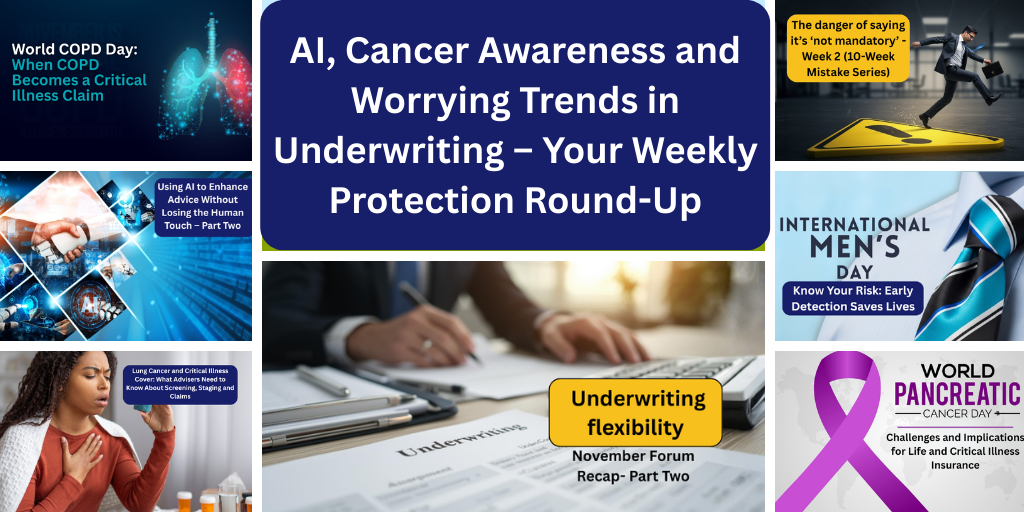
Three main themes came together in our analysis last week. First, how to use Artificial Intelligence in a way that strengthens, rather than weakens, human advice. Second, how to talk to clients about some of the most serious cancers and long-term lung conditions. Third, how insurers are really behaving when it comes to underwriting decisions.
Reading our analysis will provide practical insight into AI and advice, deep clinical guidance on lung cancer, Chronic Obstructive Pulmonary Disease and pancreatic cancer, a powerful reminder of why prostate cancer should be front and centre this International Men’s Day, and a very honest conversation from our Protection Forum on underwriting flexibility.
Taken together, the message is simple. Technology is advancing quickly, clinical practice is changing and underwriting rules remain a work in progress. Your clients still need you to join the dots, explain what it all means and make clear recommendations that protect their families when life goes wrong.
We started the week with Terry Blackburn’s second article for us Using AI to Enhance Advice Without Losing the Human Touch, which follows on from The Enduring Power of Human Connection in Lead Generation. In the latest Part Two, Terry focuses on how advisers can use AI tools without letting them hollow out the relationship.
AI chatbots and voice agents can handle routine tasks such as lead qualification, appointment booking and reminders. Used well, they save advisers hours each week and help create a smoother client experience.
But, as the title emphasises, AI should assist, not advise. It cannot understand family dynamics, show empathy or provide personalised recommendations. Good advisers stand out because of the conversations AI can never replace.
Terry also reinforces the value of retention and regular reviews. Profit and long-term trust come from looking after clients you’ve already helped, not chasing constant new leads. AI can support the process, but it cannot build relationships.
The practical lesson is simple. Use AI in the background to free up time for real conversations. Automate tasks but keep every advice discussion human.
Next, the article Lung Cancer and Critical Illness Cover: What Advisers Need to Know About Screening, Staging and Claims provides a detailed look at how screening and clinical practice are changing outcomes for clients.
The Protection Guru doctors highlight the growing impact of the NHS Lung Cancer Screening Programme, which is shifting diagnosis earlier. More cancers are now picked up at stage one or two, which improves treatment options and influences the likelihood of successful Critical Illness (CI) claims.
The article makes a critical distinction between invasive cancer, which meets the core ABI definition, and carcinoma in situ, which generally does not unless additional payment clauses apply.
Underwriting and claims decisions are heavily influenced by accurate clinical information. Advisers should support clients by helping gather structured evidence including staging, histology, biomarkers and treatment timelines.
For Consumer Duty, this content reinforces the need for advisers to explain how early detection interacts with CI cover and why definitions matter.
In World COPD Day: When COPD Becomes a Critical Illness Claim, Protection Guru explores the realities of COPD and when, in practice, it meets CI definitions.
Most people with COPD are managed successfully in the community and will not meet CI thresholds. The article explains the criteria behind severe or chronic lung disease of specified severity, typically requiring both permanent, severely reduced lung function and long-term oxygen therapy.
For advisers, this article clarifies why proactive Income Protection planning is often more appropriate for clients with moderate COPD long before CI severity is reached.
The clinical evidence needed for underwriting and claims is also outlined clearly, helping advisers support smoother, quicker decisions.
Early Detection Saves Lives This International Men’s Day brings Prostate Cancer UK’s insight into the protection conversation.
With one in eight men diagnosed in their lifetime, and one in four among black men, the risk is substantial. The piece highlights the charity’s simple 30-second online risk checker and previews the TRANSFORM trial launching in 2025.
For advisers, this is a powerful reminder to have clearer, more confident conversations with male clients about risk, screening and the implications for protection planning.
Matthew Chapman shared the second of his “Big Mistakes Series” exploring the danger of saying it is not mandatory. This looks at how optional language quietly undermines protection advice.
Phrases like “you don’t have to” or “it’s not mandatory” dilute the importance of protection and lead clients to believe it is optional rather than foundational.
Matthew’s script reframes protection as the essential base of a financial plan, aligning directly with Consumer Duty expectations.
He also challenges firms to examine their own processes and coaching, reminding leaders that culture drives adviser behaviour, and therefore client outcomes.
The article Pancreatic Cancer: Challenges and Implications for Life and Critical Illness Insurance marks World Pancreatic Cancer Day with a sobering look at one of the most aggressive cancers.
With incidence and mortality almost identical, and most diagnoses occurring late, the condition highlights why early protection planning is essential.
The article explores graded cancer severity models, contrasting them with traditional all-stage payouts. It also sets out the clinical evidence required for underwriting and claims teams.
For advisers, the key message is urgency: clients need cover in place long before symptoms appear.
The forum discussion, Protection Forum (November 2025) – Underwriting flexibility – Part Two builds on Part One which we published the previous week, and highlights several worrying trends advisers are seeing on the ground. My recommendation to anyone within Life Office senior management is to take 90 minutes and listen to what the advisers have to say in both parts of this Forum and think about how you will fix these problems.
The panel discussed inconsistent decisions, income verification problems, GP report delays and the challenges created by clients working multiple jobs with different occupational risk classes.
Mental health underwriting was a major theme, with frustration where clients are declined for life cover when an Income Protection plan with an exclusion might provide a fairer consumer outcome.
For advisers, these insights help set realistic expectations and form the basis for constructive challenge to insurers.
Bringing it all together for better outcomes
Last week’s Protection Guru content highlighted the breadth of knowledge advisers now need, from AI to clinical reality to underwriting behaviour. The common thread is responsibility. AI can support your process but cannot replace your judgement. Clinical insight helps you handle difficult conversations. Underwriting trends shape what is realistic for clients in today’s market.
Small changes in your advice process, the language you use, the evidence you gather or the way you explain risk, can deliver better outcomes for clients who need clarity, confidence and protection when life is unpredictable.