In reading this article you will understand:
- What COPD is, who it most commonly affects, and how it typically progresses over time.
- Why most COPD cases do not qualify for Critical Illness (CI) claims, and the specific criteria used in “severe or chronic lung disease of specified severity” wordings.
- The role of long-term oxygen therapy, spirometry thresholds and other clinical markers in determining whether a CI claim for COPD is valid.
- How COPD may be picked up indirectly under other CI definitions (e.g. major organ transplant, loss of a lung, intensive care/sepsis benefits), and what underwriters and claims teams usually look for.
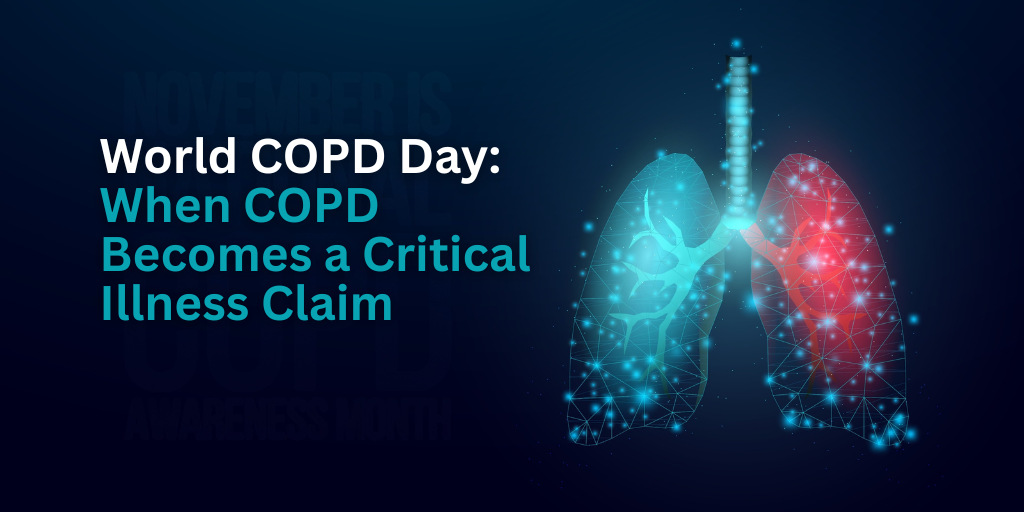
Every November, World COPD Day draws attention to one of the most common long-term lung conditions in the UK, Chronic Obstructive Pulmonary Disease.
It’s a condition that slowly damages the lungs and makes breathing more difficult over time. And while it’s life changing for many, it’s not usually the sort of illness that triggers a CI claim, unless it becomes very advanced.
What COPD actually Is
COPD is an umbrella term for two main problems:
- Chronic bronchitis – long-term inflammation of the airways, causing cough and mucus.
- Emphysema – damage to the air sacs in the lungs, reducing oxygen exchange.
Most people have a mixture of both. Over time, the lungs lose elasticity, airways narrow, and breathing becomes laboured.
It’s a progressive disease, meaning it tends to worsen gradually. But with the right treatment and lifestyle changes, people can manage symptoms and slow its course for many years.
Who it affects
COPD is most common in:
- Smokers or ex-smokers – smoking is by far the biggest cause.
- People exposed to dust, fumes, or pollution at work.
- Those with repeated chest infections or genetic predispositions.
In the UK, around 1 in 14 people over 40 live with some degree of COPD. Many aren’t diagnosed until later in life, when breathlessness starts interfering with daily activities.
How it’s treated – and why most cases don’t qualify for CI cover
In the early and moderate stages, COPD is usually managed in the community by GPs and respiratory nurses.
Treatment includes:
- Smoking cessation – this is the single most effective step to slow progression.
- Inhalers – to open the airways and reduce inflammation.
- Pulmonary rehabilitation – supervised exercise and education programmes.
- Vaccination – against flu and pneumonia, to prevent flare-ups.
- Short courses of steroids or antibiotics – during chest infections (“exacerbations”).
Most people in these stages can live independently, continue working, and maintain an active life. Because of that, these cases are not severe enough to trigger a CI claim.
When COPD becomes severe
If COPD progresses, lung function declines. Breathing becomes difficult even at rest, and oxygen levels in the blood may drop. People may need hospital treatment for flare-ups, and long-term oxygen therapy may be introduced.
This is the point where some CI policies can pay out, but only under very specific wording.
The key CI wording: “Severe or Chronic Lung Disease of Specified Severity”
Nearly all modern policies use a version of this phrase.
In simple terms, it means that the illness must have caused permanent lung damage so serious that the person relies on oxygen every day and has extremely poor results on breathing tests. Insurers set objective medical thresholds, usually:
- Spirometry results (breathing tests) showing lung function less than 50% of normal, and
- Permanent, daily oxygen therapy – not just occasional or short-term use.
If both are met, the condition is considered life altering and permanent, matching the purpose of CI cover.
Oxygen therapy
When people hear “oxygen therapy,” they often imagine a hospital setting. But there are several forms, and only permanent, daily use counts for CI purposes.
- Short-term oxygen – used in hospital or for a few days during a flare-up. This does not meet CI criteria.
- Ambulatory oxygen – portable cylinders or concentrators for people who only need oxygen when moving about.
- Long-term oxygen therapy (LTOT) – used at home for 15+ hours a day, every day, usually through nasal tubing connected to a concentrator. LTOT is prescribed after careful testing and only for people whose blood oxygen is chronically low, even at rest. It signals that the lungs are permanently damaged and unable to keep oxygen levels safe without help. This is precisely the level of severity CI wordings refer to.
Why this definition matters
CI cover is intended to pay when illness causes permanent, life-changing physical loss or impairment. For COPD, that line is drawn at:
- Irreversible lung damage,
- Severely reduced breathing test results, and
- Daily dependence on oxygen.
Anything less, such as mild COPD or intermittent oxygen use, may still cause distress or time off work, but it’s not classed as severe enough to warrant a successful CI claim.
Other ways that COPD might be covered
While COPD itself isn’t usually claimable until very severe, there are a few indirect routes:
- Lung transplant – covered under “Major Organ Transplant” if a client receives or is listed for a transplant (rare in COPD).
- Loss of a lung – some wordings pay if a whole lung is surgically removed (again, unusual for COPD).
- Intensive care benefit/Sepsis – if a severe flare-up requires ICU admission or invasive ventilation for an extended period.
These scenarios are uncommon, but worth knowing when reviewing older or enhanced policies.
Underwriting tips – When clients already have COPD
Underwriters will want to know:
- The diagnosis date and severity (usually by spirometry results).
- FEV1 and FVC readings (how much air the lungs can blow out and how fast).
- Frequency of flare-ups or hospital stays.
- Smoking history and whether they’ve quit.
- Current medications and any oxygen use.
- Functional impact (how breathless they are day-to-day).
Clients with mild, well controlled COPD may still get cover, sometimes at higher premiums. Those with severe disease or oxygen dependence are likely to be declined or postponed.
At claim stage – What evidence is needed
For a severe lung disease claim to succeed, insurers typically ask for:
- A respiratory consultant’s report confirming permanent lung disease.
- Spirometry results showing lung function below the policy threshold (usually <50% of normal). More than one reading (3 months apart) may be required to show that the drop is not temporary and to prove permanence.
- Confirmation of continuous, daily oxygen therapy prescribed indefinitely.
- Medical notes confirming there’s no expectation of recovery.
Adviser Takeaways
- COPD is common but rarely claimable under CI until very advanced stages.
- “Severe or chronic lung disease of specified severity” means daily oxygen use plus major loss of lung function, objective and permanent.
- Smoking cessation and good medical management make a big difference; clients who quit early can slow progression dramatically.
- Income Protection can be a better tool for those with moderate COPD who may have long periods off work before reaching “critical” severity.
Things to reflect on for CPD:
- Can you clearly explain to clients the difference between “having COPD” and meeting CI criteria for “severe or chronic lung disease of specified severity”?
- How could you improve the information you obtain at application to support smoother underwriting decisions?
- Are you proactively considering Income Protection and other solutions for clients with mild–moderate COPD who may have work disruption long before reaching CI level severity?