Many advisers still treat marketing and product detail as two separate worlds. They are not. Last week’s articles show the same failure pattern can occur in both places. We post social media when we have time, and we explain cover when we think it is close enough. The algorithms punish that. So do Critical Illness (CI) wordings. And clients notice.
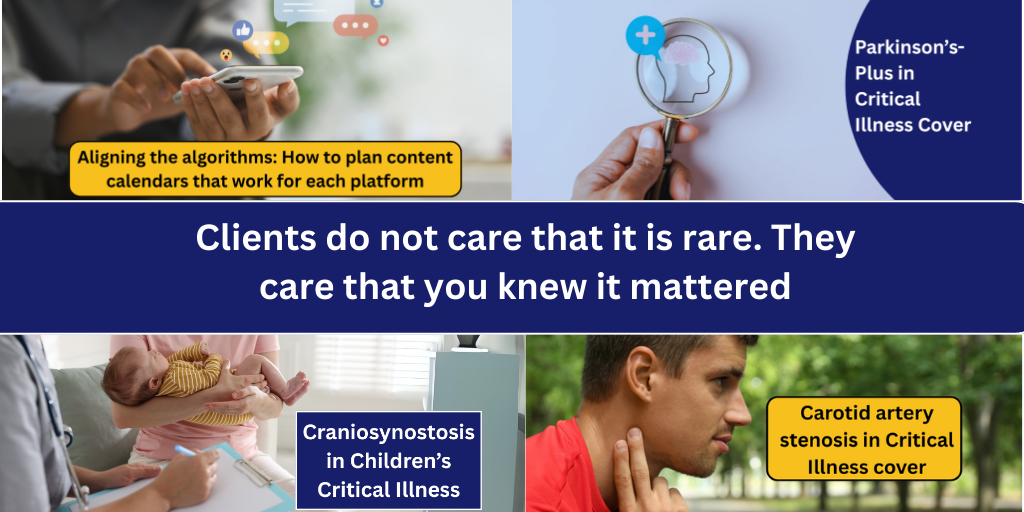
In Aligning the algorithms: How to plan content calendars that work for each platform, Christopher Miles is blunt in a useful way. Social media platforms do not reward effort, they reward signals. If your posting is sporadic, your reach drops because the system cannot predict you. If your format does not match what the platform wants, your work gets buried. His point is not about gaming anything. It is about being deliberate. Two to three LinkedIn posts a week, not ten in a burst and then silence. Daily Stories on Instagram because that is how you stay present. Short, repeatable videos on TikTok because watch time and repeat views are what the platform notices.
That is exactly how protection conversations work too. The market does not sort of pay. It pays when the wording is met and the evidence is clean. That is why the clinical pieces this week matter. They are not niche trivia. They are practical reminders that rare conditions create misunderstanding, underwriting friction and claims risk.
In Craniosynostosis in Children’s Critical Illness, the name sounds intimidating, and that alone can derail a client conversation. The facts are simple. It is when a baby’s skull seams fuse too early. Surgery is usually the standard treatment so the brain has space to grow normally. From an advice perspective the crucial point is the trigger. The insurers that include it pay on specialist diagnosis and after corrective surgery. If it is not treated surgically, there is no claim. That one line is the difference between clear expectation setting and a later complaint that a policy did not do what the client assumed.
In Parkinson’s-Plus in Critical Illness Cover, we see the adult version of the same problem. Clients hear Parkinson’s and assume one definition covers the whole family. It does not. Parkinson’s-plus syndromes are separate illnesses. They can look like Parkinson’s disease early on, but they progress faster, bring extra features, and respond less well to levodopa. Policies typically require a definite diagnosis by a consultant neurologist or geriatrician and permanent clinical impairment in movement, eye movement, posture, or cognition. The advice risk is twofold. First, clients may think they are covered under the Parkinson’s disease clause when they are not. Second, tiering matters, with some insurers placing Parkinson’s-plus in enhanced ranges only. You need to spot that before you recommend, not after a diagnosis arrives.
In Carotid artery stenosis in Critical Illness cover, we come back to operational reality. Most CI policies treat carotid procedures as a lesser or additional payment, mainly on enhanced plans. The market split is not philosophical. It is measurement. Some pay when narrowing is at least 50%. Some require 70%. Vitality also varies by product, including differences in whether stenting is in scope and whether a percentage threshold is stated. If you are recommending across insurers, you need to be able to explain why the same surgery can be treated differently, and what evidence will be needed at claim. It is easy to miss if you rely on memory instead of checking.
There is a straight line from content calendars to these clinical definitions. In both cases, consistency and specificity win. If you want better outcomes, choose a cadence for content that you can sustain, and choose a cadence for technical learning that you can sustain too. Make one small habit non-negotiable. Each week, pick one condition or one wording nuance and turn it into a short client friendly explanation. Then post it in a format the platform will actually show. You end up building reach and building trust at the same time.
The tension advisers are holding is obvious. The market is getting more competitive, and clients are getting less forgiving. You cannot bluff distribution, and you cannot bluff definitions. The advisers who win will be the ones who treat detail as a commercial advantage, not a compliance chore. Fortunately, Protection Guru exists to provide you with detailed analysis that is at the same time clear and concise. Make sure you read all the above articles in full by using the links above. You never know when that will give you the ability to show the depth of your knowledge and understanding, hence why clients need your help.