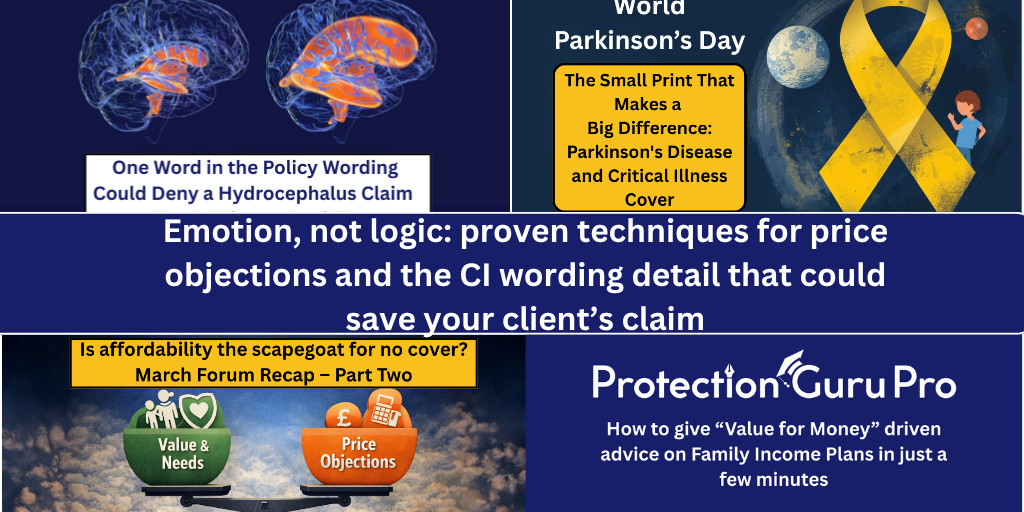
How should advisers deal with clients taking an irrational approach to buying protection? This was the message Matt Chapman and Terry Blackburn sought to address in the second part of Is Affordability the Scapegoat for No Cover? The summary of Protection Guru’s March Forum.
It is essential to understand how clients mentally approach buying protection frequently is not logical. In reality, clients frequently buy protection on emotion and justify the cost with logic afterwards, which means an adviser who leads with logic has already lost the room. Matt and Terry’s session unpacked the techniques that turn this reality into a working method. It showed how leading the conversation, rather than presenting a menu of options, is what allows the client to arrive at the decision themselves.
Matt and Terry approach the same point but from very different angles. Terry uses analogies and data to make the financial impact of being unprotected feel real before any solution is presented. The shopping basket scenario, the salary reduction scenario and his data-led method of calculating the financial value of a client’s ability to work all serve the same purpose: making the loss tangible. Matthew focuses on expectation management, spending time early in the advice process agreeing the client’s goals so that by the time recommendations arrive, the client already understands why they matter.
Both approaches share a common discipline. The adviser is not there to present a menu of options and wait for the client to choose. The adviser is there to lead the conversation so the client can see, feel and weigh the stakes for themselves. Done well, this produces something quietly powerful. The client arrives at the decision themselves rather than being sold to. As Terry put it during the session, the client has to feel that they came to the conclusion, not that they were pushed there.
That is why the price objection usually reveals the quality of the earlier conversation rather than the quality of the recommendation. If the client has not felt the emotional weight of what protection does, logic alone will not bridge the gap at the end. The words and questions an adviser chooses at the start of the process decide whether cover is seen as a cost to avoid or a priority worth protecting. If you did not catch Part One last week, both halves of the session are worth your time.
The forum is a reminder that the words, questions and framing chosen in the advice conversation shape what the client decides. Two clinical articles this week show that the words in the policy itself carry the same weight when it comes to whether a claim is paid.
The difference between “and” and “or” in a Critical Illness (CI) wording for Parkinson’s disease can determine whether your client’s claim is paid. The Small Print That Makes a Big Difference: Parkinson’s Disease and Critical Illness Cover, published on Friday to coincide with World Parkinson’s Day, sets out why. All CI plans cover Parkinson’s disease as a full payment condition. But the trigger for a successful claim varies. Some insurers require the policyholder to have developed a combination of the three main motor symptoms – tremor, rigidity and slowness of movement. Others require just one. When a condition like Parkinson’s tends to present later in life, often near the end of a CI policy’s term, the number and type of symptoms required in the wording can make the difference between a claim that pays and one that does not.
There is a further point that our doctors raise and that deserves close attention. Most CI policies require symptoms to be permanent. But as treatments for Parkinson’s improve, symptoms that are well controlled by medication may not appear permanent at the point of claim. That creates a difficult position: a client diagnosed with Parkinson’s could find their claim questioned because their treatment is working. Our doctors make a clear case that insurers should specify whether they assess symptoms with or without treatment, and this feels like exactly the kind of question the industry should be addressing in the context of Consumer Duty.
I would urge you to read the article in full. The detail on how CI plans distinguish between Parkinson’s disease, Parkinson’s plus syndromes and Parkinsonism is essential reading for anyone placing this cover.
The same principle runs through Wednesday’s article, One Word in the Policy Wording Could Deny a Hydrocephalus Claim – Here’s What to Look For. Hydrocephalus in children is treated either by inserting a shunt or by a procedure called endoscopic third ventriculostomy (ETV), which creates a new internal drainage pathway without the need for a permanent device. All the major children’s CI providers cover hydrocephalus. But some policies pay only for the surgical insertion of a shunt. If the neurosurgical team chooses ETV, which is increasingly favoured where it is suitable, a shunt-only wording will not pay.
That is a distinction most parents would never think to check. It is exactly the kind of detail that separates adequate advice from good advice. The article explains how we model hydrocephalus in our comparison system using age-specific NHS operation data, so the scoring reflects what hospitals are actually doing in practice rather than relying on assumptions about treatment frequency.
Last week’s articles share a thread. The way an adviser frames the emotional weight of a protection decision, the words in a children’s hydrocephalus clause, and the words in a Parkinson’s CI definition all share the same property: they look routine until the moment they decide an outcome. Precision in protection is not a technical nicety. It is the point where cover either works, or fails to work, for the family relying on it.
For advisers looking to build their clinical and technical knowledge across the full range of protection conditions, we produce our Protection Guru Digital Directory – the ultimate protection technical guide. It is free to access and covers the conditions, definitions and wording differences that shape real advice conversations every day.
When the difference between a claim paying and a claim being declined can rest on a single conjunction or a single procedural definition, advisers need a comparison system that goes beyond premium and provider name. Protection Guru Pro surfaces the condition-by-condition wording differences that articles like last week’s bring to light – built on analysis by our doctors, not generic policy summaries. If you have not yet seen how it handles Critical Illness comparisons in practice, the Critical Illness demo is a useful starting point.
Do you want to present your clients with a thorough analysis that shows them the cheapest plan, the most comprehensive cover and something in the middle that may offer the best value, with a condition-by-condition breakdown? If so, you may want to upgrade your protection proposition to Protection Guru Pro. Typically, 85% of clients, given the choice between the cheapest plan and a better one, go for something better. After all, they are buying cover to protect the people they care about the most.
Advisers using our system regularly find they increase their written premiums, and therefore their commission, by 20% per month. If that sounds worthwhile, next time you need to give protection advice please click the button below to get a 7-day free trial of Protection Guru Pro. Please wait until you have a case you want to test our system with.
If you are part of a firm with 10 or more advisers, please complete our Corporate Licence Enquiry Form so we can explain how we can grow your protection business and increase your revenue.