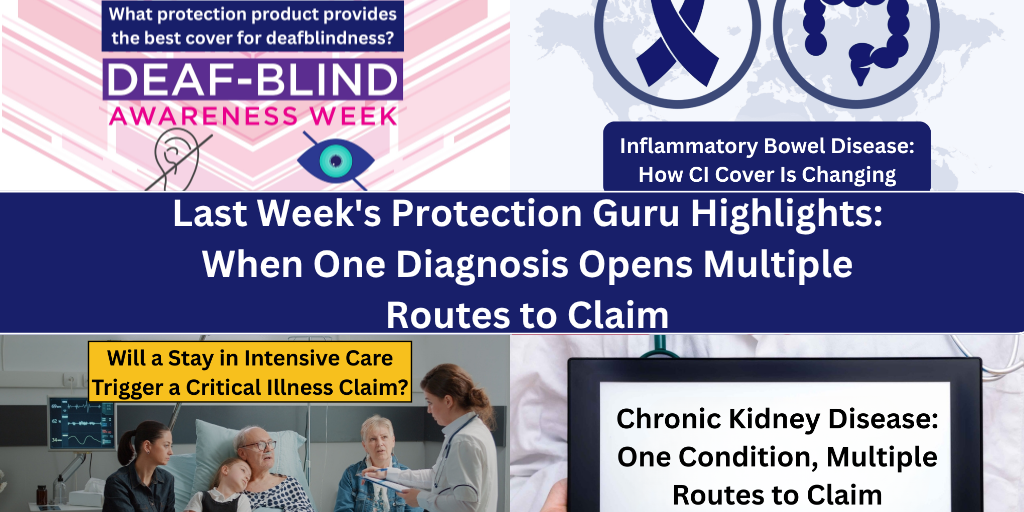
Last week’s articles on Protection Guru looked at four conditions where the cover that pays is rarely a single wording. We explored chronic kidney disease, inflammatory bowel disease, intensive care and deafblindness, and where each of these conditions sits in the Critical Illness (CI) market.
In Chronic Kidney Disease: One Condition, Multiple Routes to Claim, we get the clearest example of how the layers work together. End-stage kidney disease is covered by the kidney failure wording, which pays once the client requires permanent dialysis, and by the major organ transplant wording, which pays on transplant or on being added to the active waiting list. Around half of clients with systemic lupus erythematosus also develop kidney involvement, and several CI policies cover that scenario through the connective tissue disease wording at an eGFR below 30, well above the threshold for dialysis. Vitality’s Serious Illness Cover adds a severity-graded layer that pays partial benefits as kidney function declines, before dialysis is reached. The same client, depending on the policy in front of them, may have one route to claim, or three.
In Inflammatory Bowel Disease: How CI Cover Is Changing, the routes have multiplied recently in a different direction. The traditional wordings tied Crohn’s to two intestinal resections and ulcerative colitis to total colectomy. Both required documented surgery before a full benefit would pay. Legal & General, Royal London and Zurich have all moved to a single severe bowel disease wording, with additional payments for a single resection. Vitality’s severity-graded approach pays partial benefits for active disease that has not yet required surgery. The result is three distinct philosophies sitting on the market at once. The surgery-anchored named-disease style. The newer severe bowel disease wording. The severity-graded style. The route a client’s claim will take depends entirely on which policy was recommended at outset.
In Will a Stay in Intensive Care Trigger a Critical Illness Claim?, the routes are wider still because the wording almost never sits alone. The intensive care wording on a modern policy pays when an adult has been continuously mechanically ventilated for ten days in an intensive care unit. The bar is deliberately high, built around the small group of catastrophically unwell patients rather than routine post-operative stays. The conditions that put someone on a ventilator for that long, severe sepsis, traumatic brain injury, post-cardiac-arrest care, advanced lung failure, will often engage other wordings at the same time. Brain injury. Coma. Cardiac arrest. Sepsis. Modern policies limit double counting on a single event, but several now offer additional payments on top of the main sum. The adviser’s job at claim is to identify the route most likely to pay, and to gather the evidence that supports it.
In What protection product provides the best cover for deafblindness?, timed for Deafblind Awareness Week, the question changes entirely. Around 450,000 people in the UK live with deafblindness, projected to exceed 610,000 by 2035 as the population ages. The CI loss of sight and loss of hearing wordings are each built around severe single-sense impairment. A client with moderate loss in both senses, and severe functional impact from the combination, often meets neither threshold. The article’s conclusion is direct. For deafblindness, own-occupation Income Protection (IP) is the stronger recommendation. One study put employment among working-age adults with deafblindness at 23%, against 70% for the non-disabled population. That is precisely the kind of functional impact own-occupation IP is built to recognise.
There is a straight line across all four pieces. A serious diagnosis rarely engages just one CI wording, and on the right product it can engage several. Where it engages none, the question is whether CI is the right tool at all. Three of last week’s articles point to the work that goes into matching a client to a CI policy with the routes most likely to pay. The fourth points to the work that goes into recognising when IP, not CI, is the product that does the job.
The point worth holding on to is that protection advice does not begin and end with the headline CI claim. It is also about knowing where the connecting layers within CI add value, and knowing when a different product carries the conversation instead. Fortunately, Protection Guru exists to give you the detail on all of that. Make sure you read all the above articles in full using the links above.
We produce our Protection Guru Digital Directory as the ultimate protection technical guide for advisers, tying every awareness day and clinical condition back to the policy realities.
Whichever way your client’s situation reads, the practical question is the same. Which product, and within that product which wordings, will give them the most useful set of routes to a claim? If you have not yet seen how Protection Guru Pro handles that comparison in practice, the Critical Illness – new policies demo is a useful starting point. It is the difference between selling cover and recommending the right one.
Do you want to present your clients with a thorough analysis that shows them the cheapest plan, the most comprehensive cover and something in the middle that may offer the best value, with a condition-by-condition breakdown? If so, you may want to upgrade your protection proposition to Protection Guru Pro. Typically 85% of clients, given the choice between the cheapest plan and a better one, go for something better. After all, they are buying cover to protect the people they care about the most.
Advisers using our system regularly find they increase their written premiums, and therefore their commission, by 20% per month. If that sounds worthwhile, next time you need to give protection advice please click the button below to get a 7-day free trial of Protection Guru Pro. Please wait until you have a case you want to test our system with.
If you are part of a firm with 10 or more advisers, please complete our Corporate Licence Enquiry Form so we can explain how we can grow your protection income and tell you more about our Enterprise arrangements for larger firms.