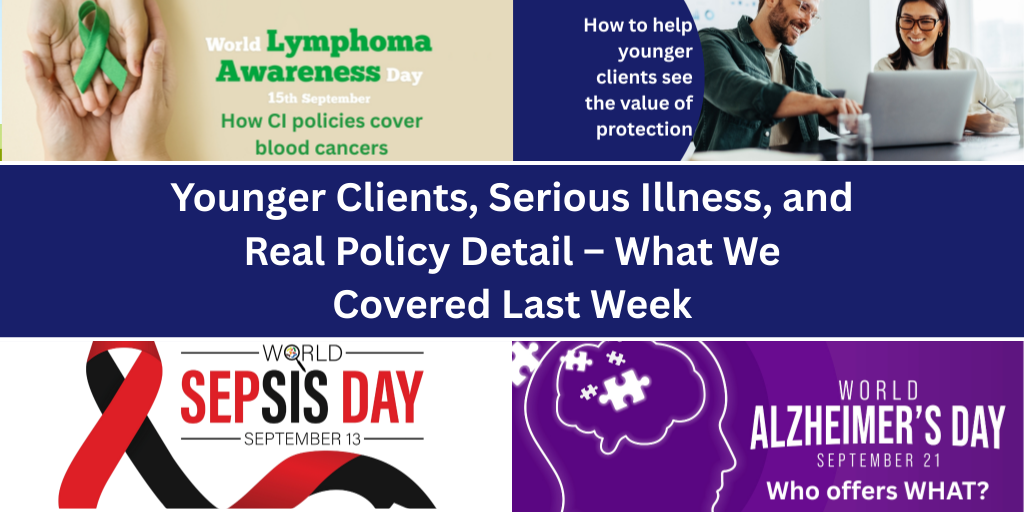
Last week’s articles offered a mix of clinical depth and commercial insight. From how Critical Illness (CI) plans now cover fast-moving medical emergencies like sepsis, to the subtleties of dementia definitions, the complexity of blood cancers, and the strategic challenge of engaging younger clients, each piece served as a reminder: good advice starts with good understanding.
We began the week with a timely clinical spotlight. In Sepsis in the Spotlight: Advising Clients with Confidence on Critical Illness Cover, we explored how modern CI definitions are evolving to keep pace with how the medical profession now defines and diagnoses sepsis. The condition kills 48,000 people a year in the UK, yet many clients won’t understand what it is or how it’s covered. Encouragingly, most leading insurers now name sepsis as a standalone condition, with full payouts typically triggered by 72 hours or more in ICU or HDU. Where sepsis isn’t named, intensive care benefits may still apply, but often only if mechanical ventilation is used, and for longer periods. This article unpacks those nuances and gives advisers four practical actions to take, including checking survival periods, capturing discharge letters, and setting client expectations realistically.
Wednesday’s How to Help Younger Clients See the Value of Protection tackled one of the most commercially urgent questions in our industry. Younger people are entering home ownership, marriage and parenthood later, if at all, meaning traditional protection triggers are arriving too late or not at all. As the article makes clear, advisers must change how they position protection. This means reframing the conversation around lifestyle security and future independence, rather than just reacting to life events. There’s also a strong case for advisers to focus more on value-added services, those features that provide tangible benefit even when there’s no claim. Real-life examples help too. As Royal London’s Gregor Sked shared, knowing someone in your 30s who is suddenly facing stage three cancer changes the tone of the conversation instantly.
On Thursday, World Alzheimer’s Day – Who Offers WHAT? explored the realities of CI cover for dementia and Alzheimer’s. Despite the huge societal impact of these conditions, nearly one million people in the UK live with dementia, CI claims remain rare. The reasons are structural: age limitations in older policies, strict severity definitions that delay payment until very late stages, and the fact that many policies lapse before claim conditions are met. That said, several insurers are trying to do better. Vitality’s Dementia and FrailCare benefit offers whole-of-life continuation beyond the standard policy term, provided it’s added from the outset. Meanwhile, both Aviva and Zurich offer enhanced payouts for early onset dementia, an important feature when supporting younger claimants. If you’re advising clients with family history of cognitive decline, these are must-know differentiators.
We ended the week with Lymphoma Awareness Day: How CI Policies Cover Blood Cancers. While the ABI cancer definition includes lymphoma and leukaemia, it doesn’t name rarer blood cancers like myeloproliferative neoplasms (MPNs), or clearly explain how cutaneous lymphoma is treated. Some insurers,, notably Legal & General and Zurich are now naming these conditions explicitly, improving clarity even where the underlying coverage hasn’t changed. Others are refining how they treat cancers “confined to the skin”, a clause that historically excluded early-stage cutaneous lymphomas. Royal London now pays a partial benefit at earlier stages than Legal & General, which pays in full at later ones. The detail is important, especially when explaining exclusions and partial claims to clients. This piece is a good example of how small wording changes can make a real difference.
Final thoughts
This was a strong week for practical learning. Sepsis and Alzheimer’s both show how definitions, survival periods and evidence requirements can directly affect claim outcomes, and why it’s not enough to rely on broad-brush policy summaries. Lymphoma shows how rare conditions expose weaknesses in vague or legacy wordings. And younger clients continue to challenge advisers to evolve both how and where they engage.
There’s also a regulatory lens here. Where cover isn’t clear, consistent or fairly explained, advisers risk breaching the FCA’s Consumer Duty obligations. Understanding policy nuance, and being able to demonstrate that you’ve explained it, has never been more important.
Wishing everyone a great week ahead!