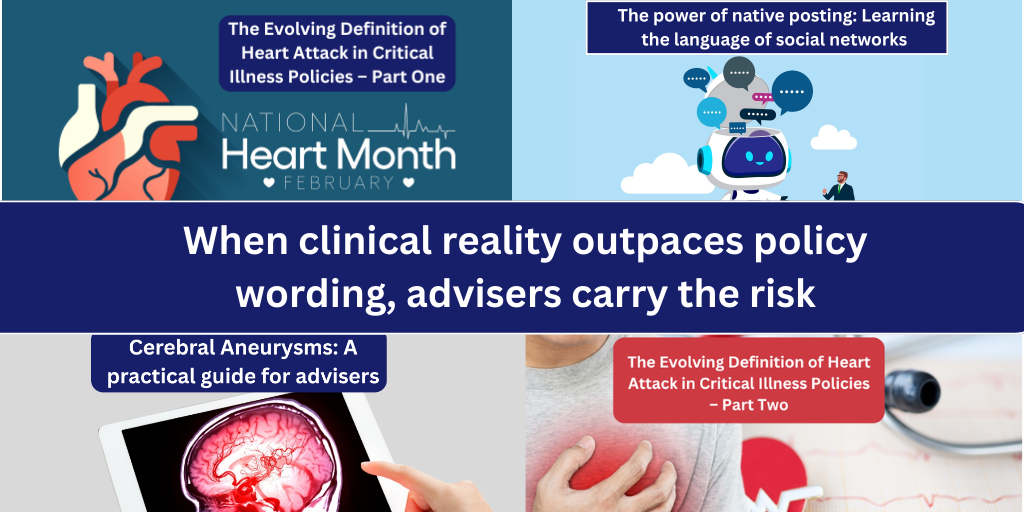
When might a heart attack, not be treated as a heart attack, under a Critical Illness policy? Most advisers would assume that cover should be clear cut. The diagnosis is obvious, the claim is straightforward, and the wording is broadly the same across providers. Last week Protection Guru showed why this is not as simple as you might expect. Over two articles our medical team took that assumption apart and set out the detail it is essential for advisers to understand.
I would urge you to read each of last week’s articles, which you can reach from the links below. Here is a summary of each and why they matter.
In The Evolving Definition of Heart Attack in Critical Illness Policies – Part One, our independent Doctors trace how heart attack definitions have changed from the 1980s to today. In the early years, insurers relied on three things: typical chest pain, new ECG changes and elevated cardiac enzymes. By the mid-2000s, troponins had replaced those older markers as the gold-standard test for heart muscle damage.
In 2014 the Association of British Insurers (ABI) raised its recommended troponin thresholds considerably – Troponin T above 200 ng/L and Troponin I above 500 ng/L – reasoning that only more severe heart attacks should trigger a claim. The problem is that high-sensitivity troponin tests were already in use in NHS hospitals by then, picking up heart attacks well below those cut-offs. Most larger hospitals have now stopped using the older tests altogether. The ABI’s thresholds are, in effect, obsolete in everyday clinical practice.
Part Two follows through to the practical consequences. Despite the shift in how hospitals work, the ABI’s most recent 2022/2023 update still references those higher thresholds. A patient may receive a clear diagnosis of a heart attack using modern testing but find their claim is measured against cut-offs that no longer reflect routine UK practice.
In reality, all major UK insurers now set those troponin figures aside. They simply require a troponin rise consistent with a heart attack, backed by standard clinical evidence. But the ABI minimum standards remain unchanged on paper, and that gap can cause confusion and, in a small number of cases, unnecessary disputes at claim stage.
Is it time for the ABI to revisit this in the context of Consumer Duty? It cannot be good for, or even fair to, consumers to have this kind of uncertainty. It is bad enough having a heart attack. Surely, we need to give greater clarity about paying claims.
The article also covers advances in cardiac imaging. Historically, policies relied on new ECG changes as the main form of objective evidence. It is now recognised that a notable proportion of heart attacks do not show classic ECG shifts. Many insurers have broadened their definitions to include echocardiography, cardiac MRI, perfusion scans and CT coronary angiography.
Only two insurers at present – Guardian and Vitality – guarantee cover for any recognised heart attack purely based on symptoms and elevated high-sensitivity troponin, without requiring imaging evidence. In practice, most confirmed heart attacks will still produce findings on a scan, so the gap between these providers and others is narrow. But it is the kind of detail that separates confident advice from hopeful assumption.
Part Two also includes practical checklists: what to provide at underwriting when a client has a previous heart attack, and what documentation to gather when making a claim. The discharge summary and troponin results are the anchor documents. Getting them early prevents most of the friction that arises when hospital paperwork records ‘myocardial injury’ without clearly stating a confirmed infarction.
If you are giving Critical Illness advice at any point, I would urge you to read the full detail of these articles. They should be invaluable from a compliance perspective.
Friday’s article, Cerebral Aneurysms: A practical guide for advisers, looks at a condition most advisers will encounter rarely enough to feel uncertain about. A cerebral aneurysm is a weak spot in a brain artery that balloons out under pressure. Many never cause trouble and are found by chance on scans. The danger comes if the aneurysm leaks or ruptures, causing a subarachnoid haemorrhage – a life-threatening type of stroke.
Two main surgical approaches are used: open surgery (craniotomy and clipping) and endovascular repair (typically coil embolisation). In NHS data the split is roughly three-quarters open surgery to one-quarter endovascular, and insurers generally accept either as qualifying treatment.
The key point for advisers is that cover is triggered by surgery, not by diagnosis. Aneurysms found on scans, even large ones being actively monitored, do not meet most policy definitions unless clipping or coiling is carried out. The article provides concise checklists for both underwriting and claims evidence. Because this condition is uncommon, there is more room for misunderstanding with clients and underwriters. Having the right documentation ready – consultant letter, operative report, imaging before and after treatment – is what prevents hold-ups at claim stage.
Wednesday’s article shifts subject entirely. Chris Miles of SM Advice explores The power of native posting: Learning the language of social networks. This highlights the importance of creating content that feels natural on the platform where it appears, rather than copying the same message across LinkedIn, Facebook, Instagram and TikTok. Each platform has its own tone, behavioural patterns and algorithmic preferences. Advisers who treat them as interchangeable are limiting their own reach.
The article walks through how to take a single core protection message – such as the importance of income protection for self-employed clients – and shape it for four different audiences. The practical guidance extends to timing, posting frequency and compliance.
There is a thread across the week worth drawing out. Three of these four articles deal with technical detail that can decide claim outcomes: troponin thresholds that no longer match modern testing, imaging evidence that can confirm or rule out a heart attack, and the surgical trigger that separates a payable aneurysm from a monitored one. That is exactly the kind of insight that sets good advice apart. But it counts for nothing if it stays inside the adviser’s head.
An adviser who understands the difference between Vitality’s heart attack definition and the ABI minimum standard but cannot get that message across on the platforms where clients and referrers spend their time is sitting on value they cannot use.
To help advisers keep this kind of analysis close at hand, we produce our Protection Guru Digital Directory. You can download the latest version and join the mailing list to receive an update every month.
That gap – between knowing and reaching – is where the real exposure sits this week. Clinical practice is moving faster than the paperwork. The advisers who treat definitions as a core skill, and who put effort into sharing that knowledge where it matters, are the ones building practices that are easier to explain, easier to trust and easier to defend.
Heart attack is one of the “Big Four” conditions where wordings can look broadly similar at first glance. The meaningful differences sit in the detail: what counts as objective evidence, whether legacy ABI thresholds are still referenced, and how much room is left for interpretation when the paperwork does not fit neatly. That is exactly where a solid comparison system earns its keep. Protection Guru Pro does the heavy lifting, working through policy wordings alongside UK audit data and clinical studies, then turning that into an overall score you can rely on.
Do you want to present your clients with a thorough analysis that shows them the cheapest plan, the most comprehensive cover and something in the middle that may offer the best value, with a condition-by-condition breakdown? If so, you may want to upgrade your protection proposition to Protection Guru Pro. Typically 85% of clients, given the choice between the cheapest plan and a better one, go for something better. After all, they are buying cover to protect the people they care about the most.
Advisers using our system regularly find they increase their written premiums, and therefore their commission, by 20% per month. If that sounds worthwhile, next time you need to give protection advice please click the button below to get a 7-day free trial of Protection Guru Pro. Please wait until you have a case you want to test our system with.
If you are part of a firm with 10 or more advisers, please complete our Corporate Licence Enquiry Form so we can explain how we can grow your protection income and tell you more about our Enterprise arrangements for larger firms.