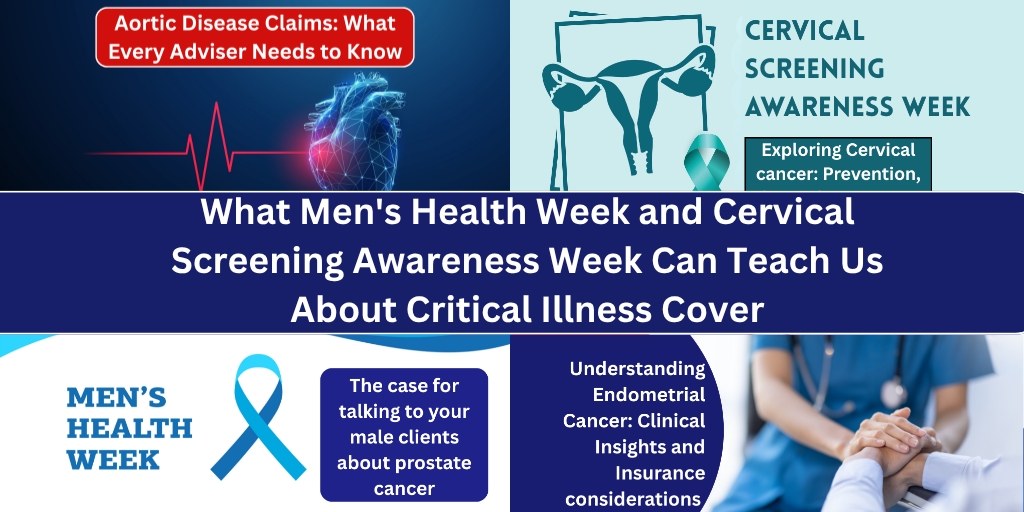
Last week’s articles highlighted an important aspect of protection advice; understanding how policy definitions and additional payment benefits apply in claim scenarios. Coinciding with Men’s Health Week and Cervical Screening Awareness Week, we explored several conditions that advisers may encounter in client conversations, from prostate and cervical cancer through to aortic disease and endometrial cancer. While clients often focus on the headline Critical Illness (CI) cover, the detail behind lower-severity conditions, additional payments and treatment-based definitions can vary significantly between insurers. As medical conditions are diagnosed and managed in different ways, these nuances can have an important impact on the benefits available to clients. Across four key conditions, we explored the clinical background, current treatment approaches and the CI policy wordings advisers should be aware of when assessing protection solutions for their clients.
In The case for talking to your male clients about prostate cancer, timed for Men’s Health Week, we get the news anchor for the week. On 28 May 2026, the UK National Screening Committee rejected universal prostate cancer screening and recommended a targeted programme for men with a confirmed BRCA2 variant and a relevant family history. Around 52,000 men are diagnosed each year in the UK, and around 12,000 die. The CI point sits at the lower end of the disease spectrum. Most policies pay an additional benefit for T1N0M0 prostate cancer with a Gleason score of 2 to 6. Some pay on diagnosis alone. Others require active treatment such as prostatectomy, radiotherapy or hormone therapy, and explicitly exclude active surveillance. Active surveillance is now the preferred NHS pathway for many early-stage cases. The wording decides whether the client’s diagnosis is a claim or a non-claim.
In Exploring Cervical cancer: Prevention, Diagnosis, Treatment and CI coverage, the same issue appears more sharply. Cervical Screening Awareness Week ran alongside Men’s Health Week. Around 3,200 new cases are diagnosed in the UK each year. Most policies have an additional payment wording for carcinoma in situ that requires either a hysterectomy or a trachelectomy. Neither is the standard NHS treatment for CIN3, the modern term for severe pre-invasive disease. The vast majority of CIN3 in the UK is treated with a Loop Electrosurgical Excision Procedure (LEEP), often in a clinic appointment, with no removal of the cervix or uterus. The additional payment for cervical CIS is, in practice, one of the most difficult wordings to trigger.
In Aortic Disease Claims: What Every Adviser Needs to Know, the lower-severity wording shifts into vascular territory. The NHS abdominal aortic aneurysm screening programme invites men in England for an ultrasound during the year they turn 65. The standard CI aortic wording is written around open graft surgery, where the diseased section is cut out and replaced. Endovascular repair, EVAR, is now the dominant elective approach for abdominal aneurysms found at screening. Under the standard wording alone, an EVAR patient does not have a successful claim. Enhanced policies have started to add a lesser payment for EVAR and TEVAR, with Vitality’s Serious Illness Cover paying 25% for endovascular repair against 75% for open graft surgery. The lower-severity layer matters here, because the lower-severity procedure is what most clients will receive.
In Understanding Endometrial Cancer: Clinical Insights and Insurance considerations, the wording problem is even more specific. Invasive endometrial cancer pays cleanly under the main cancer wording. Pre-invasive disease sits in the CIS layer, where the policy typically requires histological confirmation of carcinoma in situ and a hysterectomy. Modern UK pathology no longer uses the term carcinoma in situ for the womb lining. It uses endometrial intraepithelial neoplasia, EIN. Whether the wording recognises EIN as an equivalent term varies by insurer. Where it does not, the claim under the additional payment wording is unlikely to succeed, even where the clinical picture is identical to what the wording was originally drafted to cover.
There is a straight line across all four pieces. The additional payment wordings were drafted around the operations and labels of an earlier era of NHS practice. Active surveillance, LEEP, endovascular repair and EIN have each become standard since the wordings were written. The main cancer or main surgery clauses are still doing what they were built to do. The supplementary layer, the layer that was supposed to add value at the lower-severity end, is the one most exposed. For an adviser comparing policies on a client’s behalf, the secondary wording is where the real differentiation now sits.
This is one of those weeks where the value of detailed wording comparison shows itself. The CI lump sum still does its job at the moment of a serious diagnosis. The additional payment is where the policy is now most likely to disappoint. Fortunately, Protection Guru exists to give you the detail on both layers. Make sure you read all the above articles in full using the links above.
We produce our Protection Guru Digital Directory as the ultimate protection technical guide for advisers, tying every awareness day and clinical condition back to the policy realities.
Whichever side of the fact-find your client’s situation sits on, the practical question is the same. Which insurer’s additional payment wording will actually trigger on the procedures and labels the NHS is now using, and on what evidence? If you have not yet seen how Protection Guru Pro handles that comparison in practice, the Critical Illness – new policies demo is a useful starting point. It is the difference between selling cover and recommending the right one.
Do you want to present your clients with a thorough analysis that shows them the cheapest plan, the most comprehensive cover and something in the middle that may offer the best value, with a condition-by-condition breakdown? If so, you may want to upgrade your protection proposition to Protection Guru Pro. Typically 85% of clients, given the choice between the cheapest plan and a better one, go for something better. After all, they are buying cover to protect the people they care about the most.
Advisers using our system regularly find they increase their written premiums, and therefore their commission, by 20% per month. If that sounds worthwhile, next time you need to give protection advice please click the button below to get a 7-day free trial of Protection Guru Pro. Please wait until you have a case you want to test our system with.
If you are part of a firm with 10 or more advisers, please complete our Corporate Licence Enquiry Form so we can explain how we can grow your protection income and tell you more about our Enterprise arrangements for larger firms.