Why read this
Here is our summary of seven new or updated articles published by Protection Guru last week, turning them into practical talking points you can use with clients now. It explains why each topic matters, what to say, and how to apply it in real advice.
In reading this article you will understand:
• Explain the client value in Q3 health awareness days and use them as natural prompts for advice conversations.
• Link raised cholesterol to Critical Illness conditions and guide clients to measurable next steps.
• Apply forum takeaways to strengthen compliance, evidence, and quality over price.
• Position Income Protection as the right cover for mental-health-related absence and recovery support.
• Use Substack Part One and Part Two to build, engage, and monetise a direct client audience.
• Brief clients on liver cancer risks, red flags, and how cover usually responds.
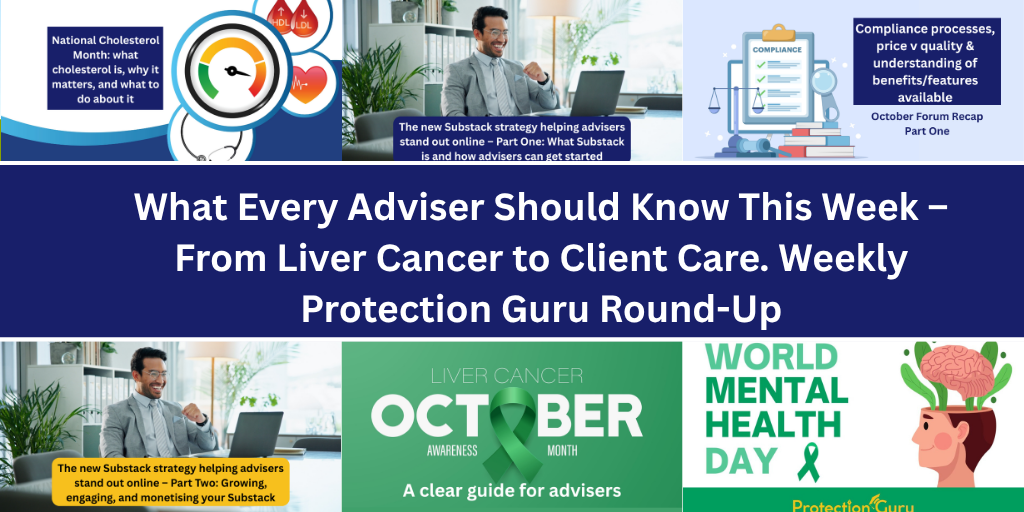
Awareness Days July to September: use calendar moments to educate and advise.
Why this matters. Awareness days create permission to talk about difficult topics. Our content is designed to help you create your own content, newsletters, blogs and similar to inform clients. This can be used to drive more interest in Critical Illness (CI) and Income Protection (IP) policies.
What to say. Pick one condition that might be relevant to clients. Use plain language to create an article you can share on what to look out for and what to consider about this illness. For sarcoma and GIST, explain that these are rare cancers of connective tissue and the digestive tract. For sepsis and Alzheimer’s, explain signs to watch and how policies define cover. For eye health, warn that wordings vary and evidence matters. Link to our condition explainers when you follow up.
How to use it. Add the awareness calendar to your client marketing rhythm. Use it to justify timely check-ups and to review suitability of existing cover. If definitions changed, discuss upgrade options.
Read more: Awareness Days July to September – Everything you need to know
National Cholesterol Month: measurable risk that maps to CI claims
Why this matters. Cholesterol is measurable and modifiable. It links directly to the CI conditions clients know. That makes it a powerful way to move from theory to prevention and evidence.
What to say. Explain LDL as the harmful parcel and HDL as the helpful one. Make the link to heart attack, stroke, angioplasty, bypass, carotid disease, peripheral vascular disease and heart failure. Stress that people often feel fine until a sudden event. That is why numbers and treatment plans matter.
How to use it. Encourage NHS Health Checks. Suggest a plan that pairs lifestyle change with clinician advice on medicines when needed. Use our October Adviser Awareness series to brief clients on what diagnoses mean and what evidence insurers look for.
Read more: National Cholesterol Month: what cholesterol is, why it matters, and what to do about it
Protection Forum recap Part 1: compliance that protects, quality before price
Why this matters. Compliance is not a box tick. It is a safety net for clients and for you. Done well, it builds trust and makes better decisions easier to defend.
What to say. Document soft facts. Explain your reasoning in plain English. Keep a clear line from needs to recommendation. Teach clients that cheapest is not best. Suitability and affordability beat headline price.
How to use it. Use tools that reveal hidden value. Virtual GPs and mental health support change real outcomes. Protection Guru Pro helps you compare benefits and price together. Train newer advisers to collect thorough fact-finds and to evidence quality choices.
Read more: Compliance processes, price v quality & understanding of benefits/features available – October Forum recap Part 1
Income Protection and mental health: cover that matches how people fall ill
Why this matters. Mental health is a leading cause of long-term absence. CI wordings rarely pay for common conditions. IP is designed for inability to work.
What to say. Set the expectation that IP pays when clients cannot perform their own job due to illness. Depression and anxiety are usually covered medical conditions. Stress on its own is not. Point out the value of built-in support. Counselling and rehab services can be faster to access than NHS routes.
How to use it. Lead with IP when income is the key risk. Explain short-term and long-term benefit periods in simple terms. Discuss relapse risk and why multiple claims over time matter.
Read more: What is the best solution for protecting against mental health issues?
Understanding Substack an outstanding new social media resource that can build real value and create new leads for you
Substack Part One: what it is and how to start
Why this matters. You need direct distribution you control. Email beats algorithms. Substack gives you a simple stack for writing, analytics and payments.
What to say. Choose a name that matches your niche and audience. Keep posts authentic and concise. Meet compliance by linking to your approved disclosures. Import existing subscribers with consent.
How to use it. Publish on a reliable schedule. Aim for useful 500 to 800-word posts. Treat it as client communication and lead generation in one place.
Read more: The new Substack strategy helping advisers stand out online – Part One: What Substack is and how advisers can get started
Substack Part Two: grow, engage, and monetise without intermediaries
Why this matters. Trust grows with consistent value and real interaction. Substack tools help you build a community then add paid tiers when ready.
What to say. Pick one or two social platforms and contribute before you promote. Use comments, polls and simple live sessions to listen and learn. Consider separate publications for distinct client segments.
How to use it. Keep your best work free to attract readers. Offer premium depth for subscribers. Track conversion and refine pricing. Grow free subscribers while you build paid support.
Read more: The new Substack strategy helping advisers stand out online – Part Two: Growing, engaging, and monetising your Substack
Liver Cancer Awareness Month: risks on the rise and how cover responds
Why this matters. Primary liver cancer is increasing. Risk is higher with alcohol-related liver disease, fatty liver linked to weight and diabetes, and viral hepatitis. Early checks save lives.
What to say. Explain the difference between primary and secondary liver cancer. List red flags in simple terms. Tiredness that does not lift. Unplanned weight loss. Pain under the right ribs. Yellowing of skin or eyes. Swelling of the tummy or ankles. Low appetite. Encourage a prompt GP visit if symptoms persist.
How to use it. Confirm that invasive liver cancer is generally a full payment under standard CI, with wording variations by insurer. Explain that carcinoma in situ is treated differently and is rare in liver practice. Note Vitality’s severity-based approach for context.
Read more: Liver Cancer Awareness Month: a clear guide for advisers
Things to reflect on for CPD:
• Add the awareness calendar to your client review timetable and choose one condition prompt per client segment.
• Run a Cholesterol Month campaign. Invite clients to NHS Health Checks and explain how results map to CI conditions.
• Update your advice file template to capture soft facts and a plain-English rationale that links needs to recommendation.
• Rehearse an IP-first conversation for clients where income is the core risk. Cover benefit period and support services.
• Launch or refresh your Substack. Set a weekly cadence and add a compliance link to your disclosure page.
• Brief your team on liver cancer risks and CI wording. Agree a simple script for red flags and next steps.
Call to action
Review the full pieces above, then compare live product quality in Protection Guru Pro on your next case. If you are not already a user, you can get a 7-day trial from Protection Guru – The ultimate guide to Life Insurance, Critical Illness & Income Protection
Why not share this round-up with your team and record CPD against the steps above.
If you want to make more use of technology to improve your business, remember to visit AdviserSoftware.com’s AdviceTech Hub.
If you want an EATT session for your firm, reply and we will arrange it.
About EATT – Empowering Advice Through Technology
Empowering Advice Through Technology (EATT) is Protection Guru and AdviserSoftware.com’s annual conference bringing together leading advice firms, technology providers, and industry experts to explore how technology can improve client outcomes and adviser efficiency.
Held at the Pullman London St Pancras, the conference includes keynote sessions, live technology demonstrations, and panel discussions on everything from artificial intelligence and data use to consumer duty compliance and digital client engagement. Delegates leave with practical ideas, tool comparisons, and an understanding of how to embed technology to enhance adviser and client experience.
Learn more at https://www.advisersoftware.com/eatt/