Most advisers assume that once a new policy goes on risk, their client is protected. That assumption is becoming dangerous. Our recent Protection Guru Forum highlighted a growing fault line that is creating significant consumer detriment and could be very damaging to the reputation of the whole protection market. While well intentioned, it appears not enough thought has been given to unintended consequences.
Last week, we also explored three conditions to give advisers clinical insight that should help them when real client situations arise.
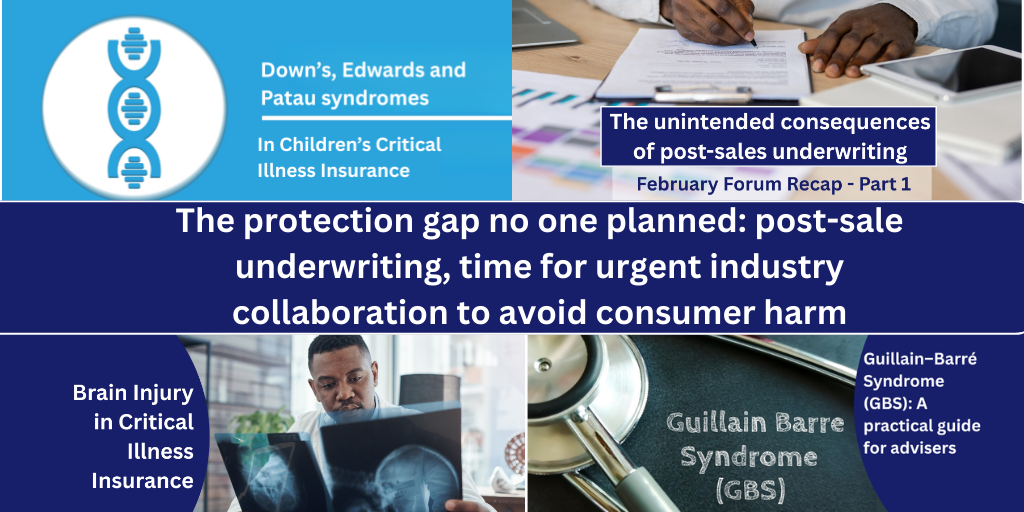
In The unintended consequences of post-sales underwriting – February Forum Recap – Part 1, our February Protection Forum panel tackled what may be the most pressing emerging issue in the protection market. Post-sale underwriting, the practice of reinsurers requiring insurers to re-underwrite cases after a policy has already gone on risk, is growing rapidly. My understanding is that some insurers are now planning to repeat the underwriting process for as many as one in five cases after the policy has gone on risk. The implications for consumers are serious.
It is crucial to recognise advisers on the call were predominantly supportive of action to ensure better disclosure, although a few raised some interesting points about the legality of the current approach. Even these comments were more about the approach being taken, not challenging the importance of thorough disclosure.
The scenario the panel described is stark. Even on standard applications having cover withdrawn will be disturbing for consumers. Where a client may have switched providers, the consequences could be even worse. As one adviser put it, a client could be stuck in no-man’s land, unable to return to the old policy, unable to keep the new one.
Advisers on the session put forward constructive ideas on how this could and should be addressed. If these changes in the way we work as an industry are necessary, there needs to be more consideration of the impact on consumers. The full comments from the Forum should be essential reading for every insurer and reinsurer, these can be reached from the link above. Part two of the session will be published this week and is equally informative. I see it as crucial that the industry works together to find a better way to address these issues to avoid a consumer loss of confidence in the protection market.
Alongside the Forum discussion, last week saw three detailed clinical articles from Protection Guru’s doctors. These are not background reading. They are practical resources advisers can turn to when a specific condition arises in a client conversation, at underwriting, or at claim stage.
In Brain Injury in Critical Illness Insurance, the article explains why some insurers have moved from separate traumatic and hypoxic brain injury definitions to a single combined wording. Real events are often messy, a car crash can cause both a direct head injury and a cardiac arrest, and split definitions created grey areas that could work against the client at claim. The combined approach asks the right question: is there permanent brain damage? For children’s cover, the article highlights two areas of small print that matter enormously: survival periods and the minimum age at which cover begins. Severe oxygen deprivation at birth is a leading cause of permanent disability, and if cover only starts at 30 days, those cases are excluded before anyone looks at the definition.
In Guillain–Barré Syndrome (GBS): A practical guide for advisers, advisers get a clear explanation of a condition most will rarely encounter but need to understand when it does arise. GBS is an autoimmune neuropathy that peaks within weeks but can take months to resolve. Most Critical Illness (CI) policies that include GBS require continuous neurological impairment for at least six months, which mirrors the real recovery timeline. The article sets out exactly what underwriters look for if there is a previous history and what evidence speeds a claim assessment. If you have a client with GBS on their medical history, this is the article to read before the conversation.
In Down’s, Edwards and Patau syndromes in Children’s Critical Illness Insurance, the focus is on three chromosomal conditions and how they sit within Children’s CI. Coverage is found almost entirely in enhanced policies. The article explains how prenatal screening, particularly the growing use of non-invasive prenatal testing, is changing the live-birth landscape and therefore the claims picture. It also highlights the real-world impact of survival period clauses and minimum age limits, which can quietly exclude the families who need support the most.
Each of these articles requires careful reading. If you are advising on CI at any point, I would urge you to read the full detail. The value is in the specifics.
As always, our Protection Guru Digital Directory covers a wide range of protection topics in depth and is available as an additional resource for advisers.
The broader point from last week is this. Whether the issue is a clinical definition or an administrative process, precision matters. In the current situation, advisers cannot assume that once a policy is on risk, this means a client is protected long term. An open-ended situation here; cover can be removed months after a plan is taken out does not help market confidence. We need a better approach.
Equally it is valuable for advisers to understand medical conditions and how they might impact at both underwriting and claims stage, which is why we produce detailed analysis from our doctors to help advisers.
Understanding how conditions are defined and how policies actually pay at claim is exactly where Protection Guru Pro adds the most value. When the difference between a successful claim and a declined one sits in the wording, whether that is a combined brain injury definition, a six-month permanence threshold, or a survival period clause in children’s cover, advisers need a comparison system built on medical expertise, not marketing summaries.
Do you want to present your clients with a thorough analysis that shows them the cheapest plan, the most comprehensive cover and something in the middle that may offer the best value, with a condition-by-condition breakdown? If so, you may want to upgrade your protection proposition to Protection Guru Pro. Typically, 85% of clients, given the choice between the cheapest plan and a better one, go for something better. After all, they are buying cover to protect the people they care about the most.
Advisers using our system regularly find they increase their written premiums, and therefore their commission, by 20% per month. If that sounds worthwhile, next time you need to give protection advice please click the button below to get a 7-day free trial of Protection Guru Pro. Please wait until you have a case you want to test our system with.
If you are part of a firm with 10 or more advisers, please complete our Corporate Licence Enquiry Form so we can explain how we can grow your protection income and tell you more about our Enterprise arrangements for larger firms.
Want to see how it works? You can watch our library of training videos here:
Protection Guru Pro Training Hub
Please note, you will need either an iPipeline or UnderwriteMe account to link to a price feed.