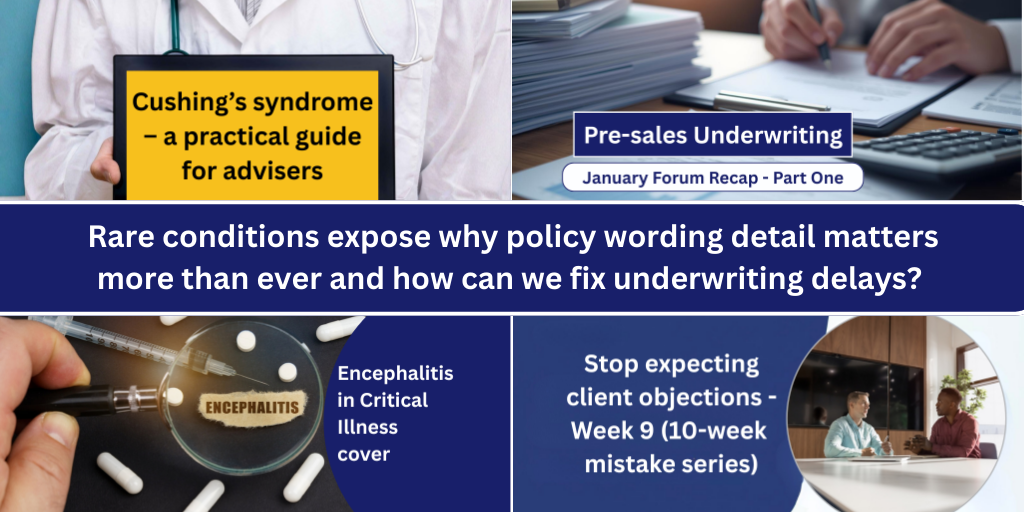
Clinically examining two rare conditions on Protection Guru last week reinforced how much real-world protection advice still hinges on wording detail. Cushing’s Syndrome – A Practical Guide for Advisers, highlighted how rare conditions expose sharp differences between insurers. Vitality remains the only provider to clearly list Cushing’s syndrome as its own serious illness condition, while others rely on partial or indirect routes through tumour definitions that may never trigger. For advisers, this is a reminder that rarity does not reduce risk. It increases the chance of misunderstanding, both at underwriting and at claim stage.
Encephalitis in Critical Illness Cover tackled a similar issue, and while Encephalitis is widely covered across the market, but most policies require permanent neurological deficit before a full payment is made. That requirement is often poorly understood by clients and sometimes by advisers. Long-term impairment is common, but it is not automatic and claims evidence must clearly demonstrate permanence. Vitality again stands apart by paying without permanence under its graded structure. These differences matter when advisers are recommending cover based on real-life outcomes. This highlights why advisers should be provided with detailed objective analysis of protection products, rather than just brochure summaries.
In the penultimate of his 10 week series Stop Expecting Client Objections – Week 9 (10-Week Mistake Series) Matthew Chapman highlighted why confidence, or the lack of it, was the thread running through latest piece in the 10-week mistake series. The argument is simple but uncomfortable. Many objections in protection conversations are not raised by clients at all. They are created by advisers who walk into the discussion expecting resistance. That expectation shows up in tone, pacing, and language. Clients feel it immediately. The practical takeaway is that protection advice collapses when advisers hedge or apologise for recommendations they believe are right. Calm conviction is not about being pushy. It is about being clear.
Finally Pre-sales Underwriting – January Protection Forum Recap – Part One provided a summary of a very informative meeting where advisers explored how pre-sales underwriting delays are now shaping client outcomes, not just adviser workflows. That was the clearest message running through this week’s protection content, and it matters because delays are no longer a back-office irritation. They are actively affecting whether clients proceed at all.
The January forum discussion on pre-sales underwriting made this uncomfortably clear. Advisers described cases stretching into weeks and months, with decisions drifting far beyond what clients expect at the point of enquiry. The issue is no longer just waiting for General Practitioner reports. Increasingly, delays are happening inside insurer underwriting teams themselves, leaving advisers managing frustration, uncertainty, and lost momentum. Digital tools help with straightforward lives, but once complexity appears, the gap between pre-sales indications and final outcomes can widen fast. That gap is where trust is tested. Lots of ideas were shared by advisers that could be solutions for insurers to what is becoming a major problem.
Taken together, last week’s content points to the same pressure point. Advisers are being asked to hold confidence, clarity, and client trust at precisely the moment when processes are slowing, definitions are tightening, and complexity is rising. That is where protection advice either proves its value or quietly unravels.