Many advisers still treat the named condition list in a Critical Illness (CI) policy as the whole product. It is not. Last week’s articles on Protection Guru showed four cases where the cover that matters lives in the architecture around it. Comparing CI policies on the name list alone misses where the claims actually pay.
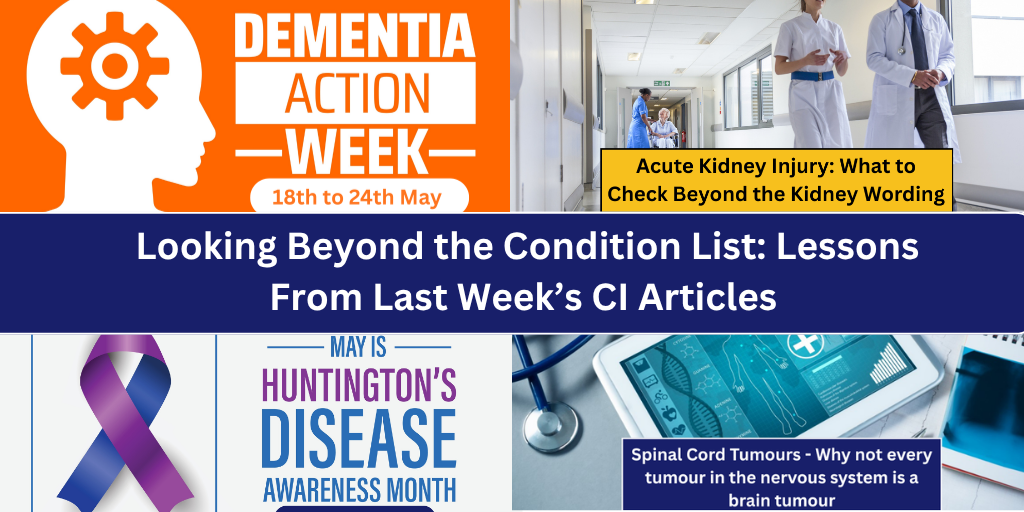
In Waiting for the Dementia Claim That Rarely Comes, timed for Dementia Action Week, we get the slow version of the problem. Dementia is the United Kingdom (UK)’s biggest cause of death, with around 982,000 people currently living with it and a projected 1.2 million by 2040. The standard CI wording, updated by the ABI in September 2022 to cover all forms of dementia rather than Alzheimer’s alone, still requires permanent loss of memory, reasoning and the ability to live independently. That is late-stage disease. For most older clients, the policy has expired by then. Young onset dementia, affecting around 70,000 people in the UK, is where standard CI cover can still pay. For everyone else, the claim usually arrives, if it arrives at all, through a different door.
In Acute Kidney Injury: What to Check Beyond the Kidney Wording, we see the fast version. Acute kidney injury (AKI) affects around 600,000 people in the UK each year, and one in five emergency hospital admissions. The standard CI kidney wording is built around permanent dialysis and transplant, both chronic disease triggers. The patient who needs three days of dialysis in intensive care during severe sepsis and then recovers does not meet either. Vitality is the named exception, with an acute renal dialysis wording on its Serious Illness Cover. Most other insurers rely on cross-coverage. A strong sepsis wording and an Intensive Care Unit wording will often pay the same client through a different route. A policy with neither leaves a substantial gap, and the kidney wording on its own will not tell you that.
In Huntington’s Disease: The Race Against Time (Part Three), the third part of the awareness month series, the architecture point lands at the level of product choice. Huntington’s is not on any insurer’s named condition list. For clients with a family history but no diagnosis, mainstream CI is generally available, sometimes with a neurological exclusion or premium loading, and a negative predictive test often returns the terms close to standard. For clients already diagnosed, mainstream CI is generally not available, and the claim, when it eventually comes, runs through dementia, total permanent disability or a catch-all severe neurological wording. Where the family includes affected relatives, the practical advice is to put cover in place before symptoms begin, and to look at insurers that underwrite individually rather than by tick-box.
In Spinal Cord Tumours – Why not every tumour in the nervous system is a brain tumour, the architecture point is one the ABI itself addressed. Around 200 of the 12,000 UK central nervous system tumours each year start in the spinal cord rather than the brain. The 2023 ABI minimum standards review clarified the wording for benign spinal cord tumours, and most modern CI policies now cover them in much the same way as benign brain tumours. The same meningioma can grow in the head, the neck or the back. Older policies with a brain tumour only wording would have left a real gap for the small number of clients affected. This is a useful in-force review point.
There is a straight line across all four pieces. The real claim often arrives through a different shape than the wording on the front of the policy. A severity-based model that pays in stages. A cross-coverage route through sepsis, ICU or stroke. A specialist insurer underwriting individually. An ABI minimum standard that has moved since the policy was sold. The adviser who knows the architecture is the adviser whose clients get paid.
The tension advisers are holding is obvious. Clients buy CI cover on a list of names. The list is not what decides the claim. The surrounding wordings do. Fortunately, Protection Guru exists to give you exactly that comparison. Make sure you read all the above articles in full using the links above.
We produce our Protection Guru Digital Directory as the ultimate protection technical guide for advisers, tying every awareness day and clinical condition back to the policy realities.
The practical question for your client’s case is the same. Which insurer’s surrounding architecture is most likely to pay, and on what evidence? If you have not yet seen how Protection Guru Pro handles that in practice, the Critical Illness – new policies demo is a useful starting point. It is the difference between selling cover and recommending the right one.
Do you want to present your clients with a thorough analysis that shows them the cheapest plan, the most comprehensive cover and something in the middle that may offer the best value, with a condition-by-condition breakdown? If so, you may want to upgrade your protection proposition to Protection Guru Pro. Typically 85% of clients, given the choice between the cheapest plan and a better one, go for something better. After all, they are buying cover to protect the people they care about the most.
Advisers using our system regularly find they increase their written premiums, and therefore their commission, by 20% per month. If that sounds worthwhile, next time you need to give protection advice please click the button below to get a 7-day free trial of Protection Guru Pro. Please wait until you have a case you want to test our system with.
If you are part of a firm with 10 or more advisers, please complete our Corporate Licence Enquiry Form so we can explain how we can grow your protection income and tell you more about our Enterprise arrangements for larger firms.