Treating protection as optional is no longer a soft behavioural advice flaw. It can be a root cause of clinical misunderstanding, underwriting shock and adviser credibility loss.
This uncomfortable truth runs quietly through everything we published last week on Protection Guru.
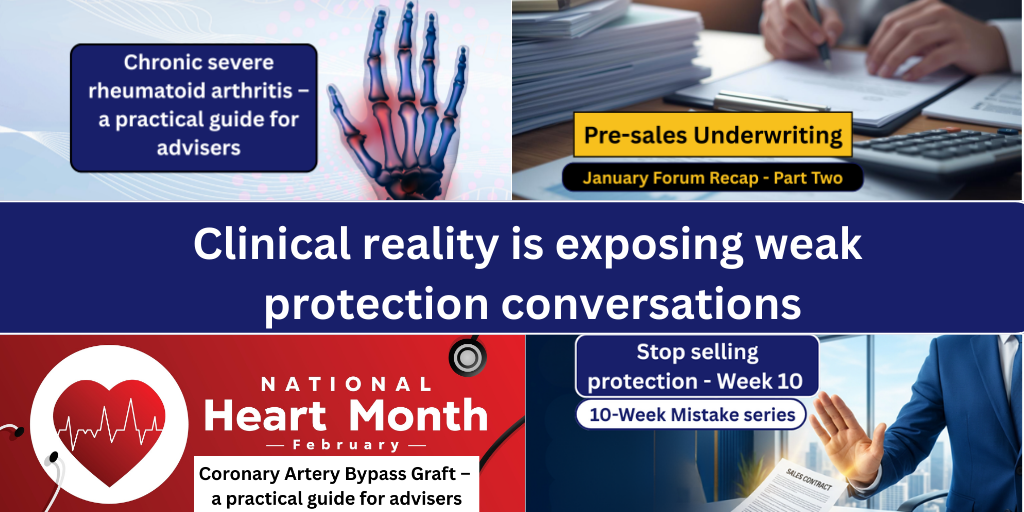
Matthew Chapman’s final piece in the 10-week series, Stop selling protection – Week 10, lands the uncomfortable truth many advisers recognise but rarely say out loud. When advisers believe protection needs selling, many signal doubt before the conversation even starts. Clients pick that up instantly. What should be a calm explanation of safeguarding becomes an apologetic pitch. Not because the client is resistant, but because the adviser has already framed protection as optional.
That belief problem matters because it distorts everything that follows. It encourages advisers to soften language, to avoid clinical depth and to rely on shortcuts to get cases through. The rest of last week’s content shows the cost of that behaviour in stark, practical terms.
Both medical guides published last week force advisers to confront how far real Critical Illness definitions sit from everyday assumptions. Chronic severe rheumatoid arthritis – a practical guide for advisers makes this especially clear. Rheumatoid arthritis is common. Chronic severe rheumatoid arthritis, as defined in most policy wordings, is not. Claims only arise once there is widespread joint destruction, visible deformity and clear loss of function across daily living activities. That often takes a decade or more, if it happens at all.
When advisers fail to explain that gap properly, clients hear reassurance where none exists. Underwriting surprises feel unfair. Claims disappointment feels personal. None of that is caused by insurer intent. It is caused by advisers treating protection as a background add-on rather than a discipline that demands precision.
The same pattern appears in Coronary Artery Bypass Graft – a practical guide for advisers. Clients talk about “heart problems” as a single event. Policy definitions do not. Heart attack, stents and bypass surgery sit under different triggers, sometimes with different payment levels, sometimes tied to the surgical approach itself. Most CABG operations still involve opening the chest. A small minority do not. That detail can change the claim outcome.
The point here is advisers need clear detailed analysis of medical conditions on an insurer by insurer basis. With this level of variation in cover, isn’t it essential to be able to give clients a condition-by-condition breakdown of what are full payment conditions and what are part payment? If you have not documented that, are you leaving yourself at risk of a claim later. This is exactly why Protection Guru Pro exists, to give advisers the detailed analysis to protect themselves and their clients confidently. If you are not presenting that level of detail to your client, are you leaving the door open to a professional indemnity claim later?
Personally, I was very disappointed that the FCA seem to have taken the insurers line that portals are not able to represent their products clearly. I take a different view, as I see it, some, not all, insurers are deliberately making it hard for advisers to meet their consumer duty obligations. They want you to choose an insurer and then just give the business to them, but is that a safe approach from a professional indemnity or regulatory perspective?
The FCA moved the goal posts on protection when they introduced consumer duty,
If advisers skim this complexity or assume tools will resolve it later, they set clients up for confusion at exactly the moment clarity matters most. Again, belief shows up upstream. Advisers who see protection as foundational take the time to explain severity, thresholds and evidence early. Those who see it as optional hope it will sort itself out.
By the time we reach Pre-sales underwriting – January Forum Recap – Part Two, the argument escalates from individual behaviour to system strain. Advisers are doing more pre-sales underwriting than ever. They are providing detailed information. Yet outcomes still diverge once applications hit full underwriting. Frustration follows quickly.
The current shortage of underwriters is leading to a catastrophic collapse in confidence in our life insurance industry. A few companies, such as Aviva and Vitality are doing the right thing and are rolling out AI services to fill the gap, other companies need examining in more detail.
What comes through clearly in that discussion is that this is not just a tooling problem. It is a consequence problem. When belief is weak and clinical understanding shallow, advisers lean harder on pre-sales tools and expect certainty they were never designed to give. When outcomes change, trust erodes. Not just in insurers, but in the adviser relationship itself.
Taken together, last week’s articles point to the same conclusion. Protection advice does not fail at the policy stage. It fails much earlier, when advisers treat protection as something to persuade rather than something to assert with confidence, accuracy and clinical realism.
The behavioural reset is simple, but you need the right tools to do it. Stop softening. Stop assuming resistance. Make the tools do the hard work and give you the detailed knowledge you need to do the job thoroughly. If protection genuinely underpins the financial plan, it has to sound like it from the first sentence.
That is where better outcomes start.