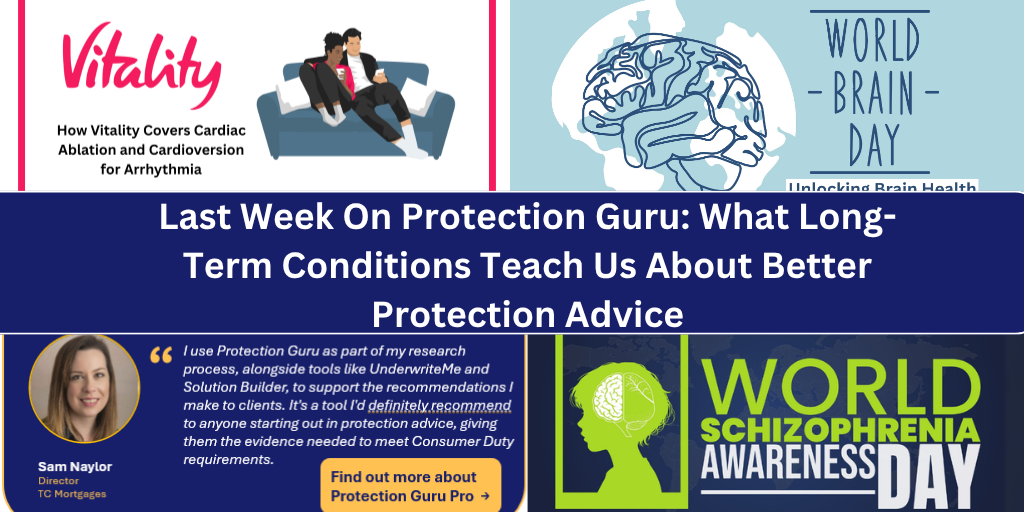
Last week’s articles on Protection Guru concentrated on the conditions that clients live with over time rather than face as a single event. Recurring cardiac arrhythmia treated by cardioversion and ablation. Severe mental illness that affects how a person thinks, feels and behaves. Cognitive decline that builds up slowly through the years, shaped by the same risk factors that drive vascular disease. A fourth piece showed how to compare Income Protection (IP) policies with confidence using Protection Guru Pro.
In How Vitality Covers Cardiac Ablation and Cardioversion for Arrhythmia, we get a specific example of cover shaped for a condition that comes back. Cardiac arrhythmia is an irregular heartbeat, of which atrial fibrillation is the commonest form. The two main treatments are cardioversion, a controlled electric shock to restore normal rhythm, and ablation, in which the small patches of tissue firing off the faulty signals are destroyed via a catheter. Cardioversion frequently works first time but often does not last. Ablation is more durable but often follows a course of medication or a prior cardioversion. Vitality’s Serious Illness Cover names both. Cardioversion requires at least 40 joules of electrical energy applied under medical supervision, and the arrhythmia recorded on an electrocardiograph (ECG) that Vitality can see. Ablation is worded as the surgical or endovascular division of abnormal conduction pathways, with the same ECG evidence requirement. Because Vitality pays on a severity scale and the rest of the cover stays available after a partial payment, a client cycling through cardioversion and ablation over the years may claim more than once on the same policy.
In World Brain Day: Unlocking Brain Health Through Lifestyle, the frame widens. The 2024 Lancet Commission on dementia estimated that around 45% of dementia cases worldwide could in theory be prevented or delayed by addressing fourteen modifiable risk factors across the life course. Several are cardiovascular: high blood pressure, smoking, obesity, diabetes and physical inactivity. Untreated vision loss and high LDL cholesterol were added to the list in the 2024 update. The point advisers can usefully take from this is that the same lifestyle work that protects the heart also protects the brain. Value-added services on many modern protection policies now touch on some of this territory, from health assessments to nutrition and physical activity support. For clients concerned about a family history of dementia, the practical protection conversation increasingly runs alongside a prevention conversation, not just a cover-when-diagnosed conversation.
In Schizophrenia Awareness and Insurance Coverage in the UK, timed for National Schizophrenia Awareness Day, we get the clearest example of a wording evolving to match modern clinical practice. Schizophrenia affects around 1 in 100 people over a lifetime. Only around 13% of adults with schizophrenia are in any form of employment. NHS care has shifted away from long hospital admissions towards intensive community-based treatment, particularly through Crisis Resolution and Home Treatment Teams (CRHTTs) that visit clients at home during acute episodes. A number of enhanced Critical Illness (CI) policies now accept 14 consecutive days of CRHTT care as equivalent to a 14-day in-patient admission for the purposes of a schizophrenia claim. IP responds more broadly still, covering mental illness on equal footing with physical illness, and mental health now accounts for around a third of all new IP claims in the UK.
The final piece of the week, Making Light Work of Income Protection Comparisons, is a short demonstration of how Protection Guru Pro handles an IP comparison, ordering results by quality rather than price and using the budget tool to show a client why a marginally dearer plan can be far better value. For any adviser writing IP regularly, it is worth ten minutes.
There is a thread across all four pieces. The clinical picture in each is not a one-off event but a long-run condition. Arrhythmias that recur. Mental illness that lives with the client for years and needs different care in different periods. Cognitive risk that builds up across decades. The cover that fits these situations is rarely a lump sum paid once and the policy closed. It is a severity-graded structure that pays in stages, a wording that recognises modern care pathways rather than only hospital admissions, and an IP contract that pays income for as long as the client cannot work. Fortunately, Protection Guru Pro is built exactly to surface that detail.
We produce our Protection Guru Digital Directory as the ultimate protection technical guide for advisers, tying every awareness day and clinical condition back to the policy realities. Click the link above to read the latest issue.