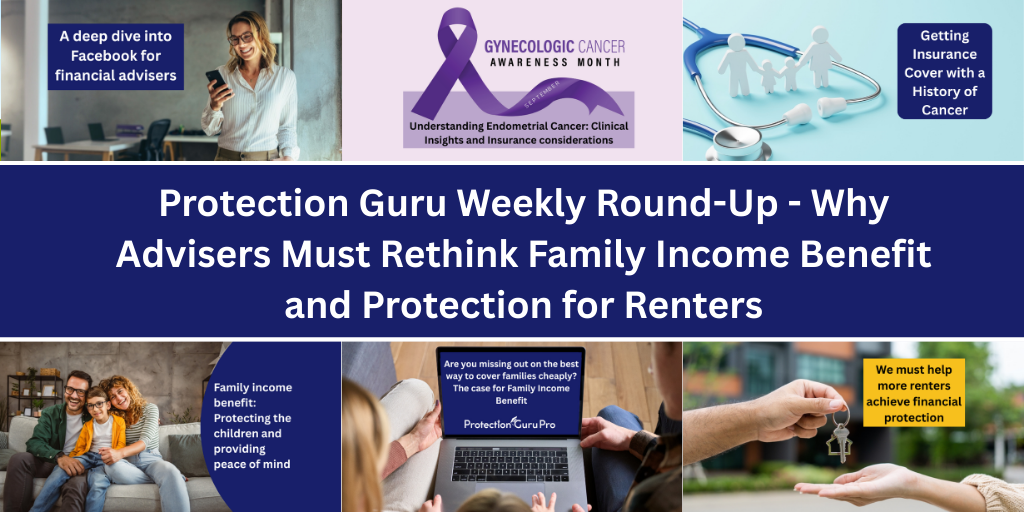
Last week took us from the digital front line of adviser marketing, through the complexities of cancer underwriting, to the often-overlooked protection needs of families and renters. What links them all is the same challenge: how do advisers deliver better outcomes under Consumer Duty, in ways clients can genuinely understand and value?
We began the week with A deep dive into Facebook for financial advisers. Too many advisers dismiss Facebook as a place for family photos, but Christopher Miles shows it’s still one of the most effective platforms for trust-building and relationship marketing. Story-style posts, myth-busting content, and live Q&As resonate strongly with clients in their 30s to 60s, exactly the life stages where protection advice is needed most. The lesson is simple: be visible, be human, and use Facebook as a relationship builder, not just a noticeboard.
On the same day we published Understanding Endometrial Cancer: Clinical Insights and Insurance considerations. September marks Gynaecological Cancer Awareness Month, and our independent doctors explained how conditions like endometrial cancer are diagnosed and treated, and, importantly for advisers, how they are covered in CI policies. The distinction between invasive cancer, carcinoma in situ, and newer terms such as endometrial intraepithelial neoplasia (EIN) is critical. Clients may hear “early stage” and assume it means a claim is payable, but unless the cancer is invasive, most standard definitions will not respond. This is where advisers must explain clearly, with empathy, and ensure clients understand the limitations as well as the benefits.
Our midweek article, Getting Insurance Cover with a History of Cancer, tackled one of the hardest realities in protection. Cancer survival rates are improving, but underwriting remains complex. Time in remission, type and stage, family history, and lifestyle all matter. Advisers can help clients by preparing complete medical records, understanding which insurers are more pragmatic, and timing applications carefully. At the same time, Europe’s growing “Right to Be Forgotten” movement shows how other markets are finding ways to give cancer survivors a fairer chance at cover. For UK advisers, being aware of these developments can help manage client expectations.
Family Income Benefit dominated Thursday’s content. In Family income benefit: Protecting the children and providing peace of mind, Matthew Chapman highlights that FIB is about more than income replacement, it’s about ensuring children are cared for emotionally and financially. Structuring policies in trust, and naming guardians as trustees, means the benefit goes directly to the people raising the children if both parents are gone. This transforms the protection conversation, often leading to new referrals as guardians ask how they can protect their own families.
We followed this with Are you missing out on the best way to cover families cheaply? The case for Family Income Benefit. Too often, advisers default to lump sums. Yet from a Consumer Duty perspective, a regular, guaranteed income can be easier for bereaved families to manage and provides clear, ongoing value. Protection Guru Pro remains the only tool that allows advisers to compare FIB quality alongside cost, helping demonstrate value in a way that is easy to evidence and explain.
We closed the week with Martin O’Connell’s We must help more renters achieve financial protection. With 5.4 million privately renting households in the UK, and just 6% holding Income Protection, the gap is staggering. Renters are often ignored because they lack the mortgage trigger, but their financial vulnerability is clear. Advisers should flip the usual sales order on its head: start with illness and income needs, then consider death. For renters, and arguably for many others, this approach makes more sense.
Together, last week’s insights underline the breadth of opportunities for advisers to improve outcomes. Whether it’s using Facebook more intelligently, explaining CI definitions with clarity, guiding cancer survivors through underwriting, structuring FIB to protect children, or finally addressing the renters’ market, the common thread is clear: Consumer Duty isn’t about ticking boxes. It’s about demonstrating value in ways that clients truly understand.
Have a great week everyone!