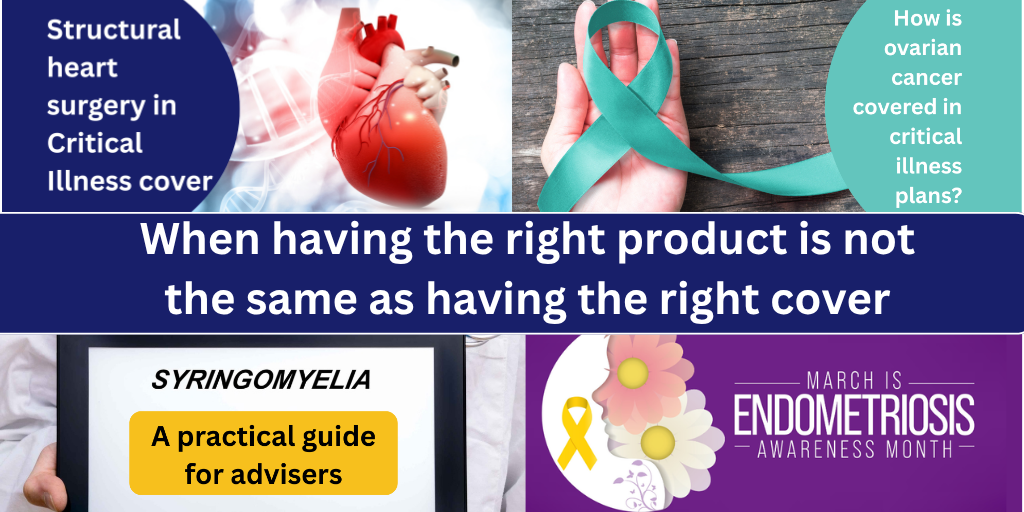
Do you know which condition affects one in ten women of reproductive age in the UK and is not included in any Critical Illness (CI) plans? If not, the articles linked below should be essential reading. Income Protection (IP) would be a better way to address this condition, but there are key factors you need to take into account.
Last week’s four articles on Protection Guru addressed conditions where the difference between adequate protection and genuine protection is decided by clinical detail. Two of those conditions have awareness months in March. All four have something important to teach any adviser who may encounter them in a client’s medical history. These highlight why and makes clear a situation where one insurer provides any cover at all.
Endometriosis and Insurance arrives as Endometriosis Action Month continues. The condition affects roughly 1 in 10 women of reproductive age in the UK and is absent from CI policies entirely. IP is the natural product to consider, but the article shows why even IP does not always work as expected for this client group.
The structural difficulty is the deferred period. Endometriosis is cyclical. A client may experience significant time off work across a year without any single episode lasting long enough to exhaust a standard deferred period in one continuous stretch. The article explains how linked claims provisions within some policies can help, and how underwriters approach applications where there is a history of work absence. The practical advice for application preparation is specific and useful. I would urge every adviser who places IP for female clients to read this in full.
How is ovarian cancer covered in Critical Illness plans? is published for Ovarian Cancer Awareness Month. More than 7,000 women are diagnosed in the UK each year, with around 60% presenting at a late stage when treatment is more difficult. The headline answer on coverage is encouraging: all CI plans cover malignant ovarian cancer within their main cancer definition. More comprehensive plans go further, and the article explains the clinical distinction that drives those additional payment conditions.
The underwriting picture following a diagnosis is where advisers need to read carefully. The article sets out what information is typically required, what to expect in terms of waiting periods and loadings, and where applications are most likely to face difficulty. There is also a point about genetic testing that every adviser should know. Under the Code on Genetic Testing and Insurance, clients are not required to disclose the results of predictive tests, including BRCA1 and BRCA2 results, regardless of the policy type or value. Advisers who understand this can give accurate guidance to clients considering genetic testing for health reasons who are concerned about the insurance implications.
Structural heart surgery in Critical Illness cover addresses a clause that rarely attracts attention in the adult market. Across the market, the wording covers major cardiac surgery requiring a chest opening through the sternum (a median sternotomy) as a catch-all for operations that fall outside the specific headings for bypass surgery, valve repair and open aortic procedures. In practice, this mostly means surgical repair of holes in the heart’s internal walls.
The adult picture is limited. Most procedures for atrial septal defects in adults, and virtually all patent foramen ovale closures, are now performed by catheter rather than open surgery, which means the standard clause rarely pays in the adult population. The article explains where Vitality’s SIC 3 departs from the rest of the market and why that distinction matters when placing cover. The more immediate relevance is in Child CI: congenital heart problems are more common in children, surgical repair through the chest still accounts for a larger share of paediatric treatment, and the structural heart clause is correspondingly more likely to be used.
Syringomyelia (and Syringobulbia): A practical guide for advisers is the kind of article that earns its place the moment an unusual condition appears in a client’s medical history. Syringomyelia describes a fluid-filled cavity that forms inside the spinal cord when cerebrospinal fluid flow is disrupted, most commonly by a structural abnormality at the base of the skull. The condition is uncommon, but MRI scanning now detects more cases than would previously have presented clinically.
The key point for CI advice is that cover follows surgery, not the scan finding. A client can have a confirmed cavity and receive no CI benefit at all if the condition is managed without an operation. The article explains why this is, what triggers a valid claim, what information is needed at underwriting and claims stage, and how to explain the condition to a client. These are not details to work out at the point a claim arises.
As always, our Protection Guru Digital Directory covers a wide range of protection topics in depth and is available as an additional resource for advisers.
Four conditions this week, each with a clinical layer that most policy documents do not surface. For endometriosis and ovarian cancer, the awareness months provide a prompt, but the clinical detail in these articles repays reading beyond March. For structural heart surgery and syringomyelia, there is no calendar marker and no recurring prompt. The client who needs that knowledge arrives without warning.
When the meaningful differences between policies sit in clinical wordings rather than premium levels, the comparison system that adds most value is one built on medical expertise. That is what Protection Guru Pro delivers.
Do you want to present your clients with a thorough analysis that shows them the cheapest plan, the most comprehensive cover and something in the middle that may offer the best value, with a condition-by-condition breakdown? If so, you may want to upgrade your protection proposition to Protection Guru Pro. Typically 85% of clients, given the choice between the cheapest plan and a better one, go for something better. After all, they are buying cover to protect the people they care about the most.
Advisers using our system regularly find they increase their written premiums, and therefore their commission, by 20% per month. If that sounds worthwhile, next time you need to give protection advice please click the button below to get a 7-day free trial of Protection Guru Pro. Please wait until you have a case you want to test our system with.
If you are part of a firm with 10 or more advisers, please complete our Corporate Licence Enquiry Form so we can explain how we can grow your protection income and tell you more about our Enterprise arrangements for larger firms.
Want to see how it works? You can watch our library of training videos here:
Protection Guru Pro Training Hub
Please note, you will need either an iPipeline or UnderwriteMe account to link to a price feed.