Knowing the best way to approach Critical Illness (CI) claims is a key skill for advisers. The claim is when you demonstrate the value in all you do. In that context, last week’s articles should be a treasure trove of valuable learning and development content. Last week we produced four different studies looking in detail at situations that could trigger claims, and the detail advisers need to know.
This is a deliberate change in direction for Protection Guru content. In the coming months you are going to see a growing number of such studies as we build a comprehensive range of training material for advisers. As part of this process we are adding the detail of what advisers need to know about individual conditions both at the underwriting and claims stage.
To help advisers keep this analysis close at hand, we now produce our Protection Guru Digital Directory. You can download the latest version and join the mailing list to receive an updated version every month. A key part of the Digital Directory is the Body Diagram through which we are building a comprehensive summary of medical conditions to help advisers.
I would urge you to read each of last week’s articles which you can reach from the links below. Here are some brief details of each:
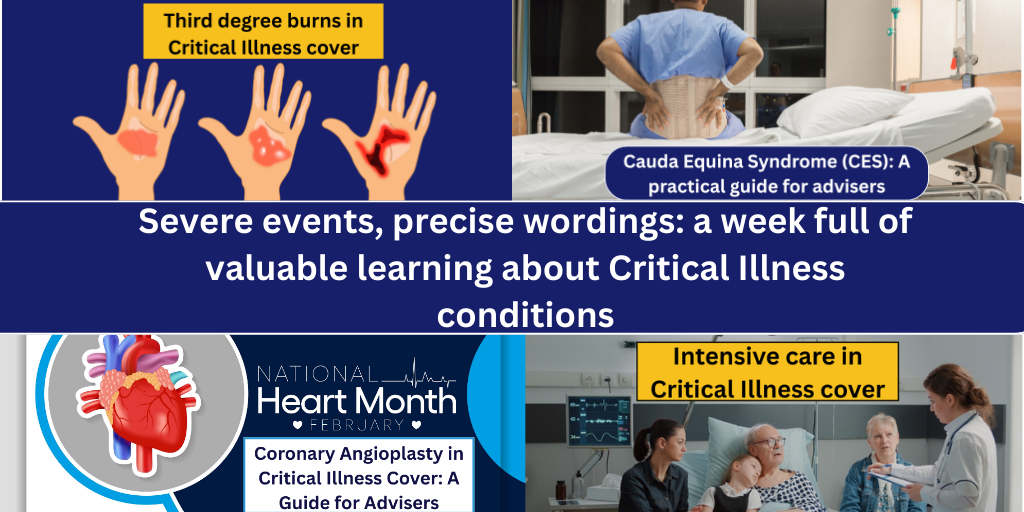
In Third degree burns in critical illness cover, we get a clean example of why detail decides outcomes. The Association of British Insurers (ABI) minimum definition is built around full thickness burns and a threshold of Total Body Surface Area (TBSA). On paper that looks simple. In practice, the difference between 5%, 10% and 20% of body surface area can be the difference between no payout, a partial payout and a full sum assured. The market has also moved beyond the bare minimum, with some insurers adding face or head criteria because disfiguring burns can be life changing even when the overall area is below 20%. The adviser takeaway is basic but often missed. Do not assume the condition name does the work. The claim will live or die on the burns unit charting of depth and percentage.
It is also crucial to understand how Intensive care cover works in critical illness cover. A client or family will say someone was ‘in ICU’. Many policies are not paying on the label. They are paying on invasive ventilation for a set number of consecutive days in an Intensive Care Unit (ICU), typically via tracheal intubation. The point is to capture a rare, extreme level of illness and to avoid paying on short, expected ICU stays after planned surgery. The practical move is simple. If the admission ever turns into a claim, do not rely on anecdote. Ask for the discharge summary and the intubation and extubation dates, and check survival periods and any relevant exclusions.
In Coronary angioplasty in critical illness cover: a guide for advisers, we see where advisers can accidentally oversimplify. Clients often hear ‘stent’ and assume it is automatically treated like a heart attack. It usually is not. Most plans pay myocardial infarction (heart attack) in full when the definition is met, but treat Percutaneous Coronary Intervention (PCI) as a partial payment condition. That is not a judgement call about seriousness. It reflects how definitions separate permanent heart muscle damage from treatment for narrowing that may be significant but not necessarily a heart attack. Definitions vary too. Some focus on how many main coronary arteries were treated, some treat left main stem intervention as especially significant, and some lean on a percentage stenosis threshold. At underwriting and claim stage, the catheter lab report is the anchor document. It proves what procedure happened, which vessel was treated, and whether it was part of a heart attack admission or a standalone intervention.
Finally, Cauda equina syndrome (CES): a practical guide for advisers pulls together the clinical and claims realities in a way advisers can use. Clinically, CES is an urgent spinal emergency where delay can increase the risk of long-term neurological harm. From a cover point of view, CES is more commonly found in enhanced ranges than in core products, and the market approach varies. Many definitions focus on permanence. A specialist diagnosis plus permanent bladder dysfunction alongside persistent leg weakness and/or sensory loss is a common shape. Some wordings also require permanent bowel dysfunction, which narrows payability. The advice risk is expectation setting. A diagnosis alone is not enough for a successful claim if permanence is the trigger. The practical fix is to build a clean file: timeline, Magnetic Resonance Imaging (MRI) results, operative notes, and a clear current status summary around continence, mobility and neurological deficits.
There is a commercial angle here as well as a technical one. Advisers who treat definitions as a skill set tend to place cover that is easier to explain, easier to underwrite, and easier to claim against. The habit to build is small. Each week, pick one definition and one ‘anchor document’ that proves it. Then use that in client conversations and provider comparisons. You end up reducing complaints risk and increasing trust at the same time.
One great way to reinforce the value of all you are doing and the extent to which you are analysing what is best for a client when taking our CI cover is to provide them with a comprehensive analysis of plans in the market, based on detailed analysis of policy wordings carried out by a panel of eminent medical practitioners. When it comes to reading and understanding and benchmarking complex medical wordings, it is hard to take seriously any suggestion that there is anyone better qualified than doctors to carry this out. After all it takes them 7 years to qualify and they are in the front line of treating patients day in, day out.
That is why Protection Guru Pro is the most comprehensive value for money protection research system in the market. Not only will it give unparallel medical opinions on CI cover, but you can produce detailed value for money analysis for a full range of protection term products including Income Protection, Term Assurance, Family Income Benefit and Business Protection.
Do you want to present your clients with a comprehensive analysis that lets you show your clients the cheapest plan, the most comprehensive cover and something in the middle, which may be best value, with a condition by condition breakdown of the level of cover for each condition?
If you do, you may want to upgrade your protection proposition to Protection Guru Pro. Typically 85% of clients, given the choice between the cheapest plan and a better one, go for something better. After all, they are buying cover to protect the people they care about the most. So, do they really want a cheap contract or best value? Also, advisers using our system regularly find they typically increase their written premiums, and therefore commission by 20% per month.
If this sounds attractive, next time you need to give some protection advice, please click the button below to get a 7-day free trial of Protection Guru Pro, but please wait until you have a case you want to test our system with.
Alternatively, if you are part of a firm with 10 or more advisers please complete our Corporate Licence Enquiry Form, so we can tell you how we can significantly grow your protection income and you can learn more about our Enterprise arrangements for larger firms.
Want to see how it works? You can watch our library of training videos here:
Protection Guru Pro Training Hub on Vimeo
Please note, you will need either an iPipeline or UnderwriteMe account to link to a price feed.