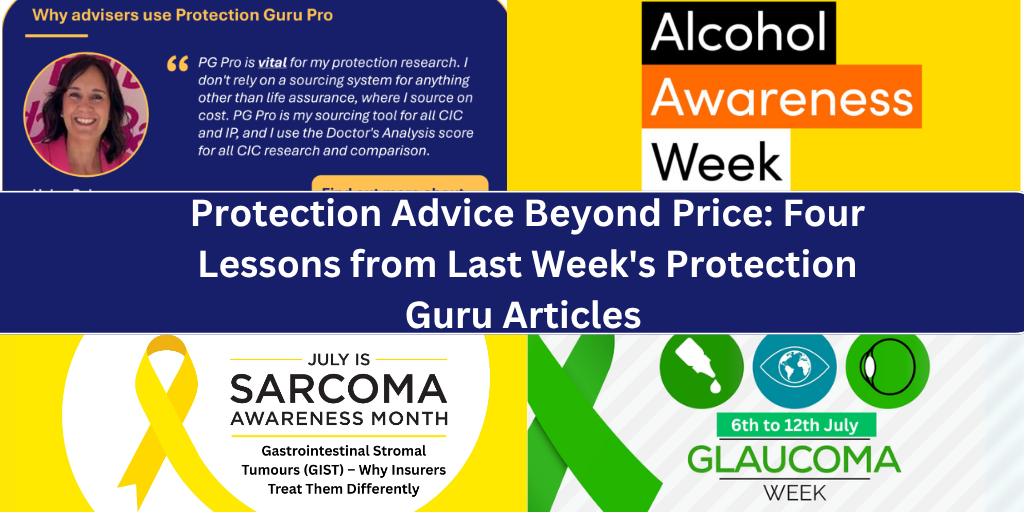
Last week’s articles on Protection Guru looked at three conditions where a specific threshold, expressed as a number or a grade, sits quietly between a diagnosis and a claim. Glaucoma. Gastrointestinal stromal tumours. Alcohol consumption at underwriting. A fourth piece looked at how Protection Guru Pro handles legacy Critical Illness (CI) comparisons.
In Glaucoma and Critical Illness Cover: Not All Definitions See Eye to Eye, timed for Glaucoma Awareness Week, the threshold is 20 degrees of visual field. More than 700,000 people in the UK live with glaucoma, around half undiagnosed. The condition is progressive and painless, and the first vision lost is peripheral. Most CI policies use the ABI two-limb wording for severe visual impairment: acuity of 6/60 or worse in the better eye, OR visual field reduced to 20 degrees or less. Either limb triggers the claim. Scottish Widows is the outlier, requiring 3/60 acuity, or 6/60 combined with visual field loss. For a glaucoma patient with preserved central acuity and progressive field loss, the combined test is materially tougher, and the doctors’ panel scores it at 40 out of 100 against 85 for the standard market. Guardian’s additional payment wording is the only one on the panel that names glaucoma specifically, paying 50% of the sum assured at acuity of 6/24 with moderate field contraction, or at better acuity where field loss is marked.
In Gastrointestinal Stromal Tumours (GIST) – Why Insurers Treat Them Differently, the threshold is WHO Grade 2. GIST is a soft tissue sarcoma that starts in the digestive tract, most often the stomach or small intestine. Historically many small GISTs were described as being of uncertain malignant potential, and interpretation of the CI cancer wording varied between insurers. The ABI’s September 2022 review of its CI minimum standards drew a line. The model cancer wording now excludes GISTs without lymph node involvement or distant spread unless they are WHO Grade 2 or above. A small low-grade GIST that has not spread will not meet the standard cancer definition. A Grade 2 or higher GIST, or any GIST with spread, is covered in full. Some insurers have moved excluded low-grade GISTs into a lesser payment category, while others exclude them entirely. The distinction between Grade 1 and Grade 2 sits in the histopathology report and can be the difference between a full CI payment and no payment at all.
In Alcohol Awareness Week: Rethinking Our Relationship with Alcohol, the thresholds are the unit levels that shape underwriting. Every protection application asks about weekly alcohol consumption. Consumption at or near the NHS guideline of 14 units a week has no effect on terms. Industry experience suggests further questions typically start somewhere around 35 units a week, loadings become likely as intake climbs towards 50, and very heavy consumption leads to postponement or decline. History of dependence, treatment for alcohol misuse, or abnormal liver function tests will prompt closer scrutiny including a GP report. Accurate disclosure at application matters as much as the number itself. Several CI and Income Protection (IP) definitions carry alcohol-related carve-outs, most obviously the liver failure wording, which commonly excludes cases caused by alcohol misuse. Helping a client estimate their units honestly is one of the simplest ways to protect a future claim from misrepresentation questions.
The final piece of the week, Running a Legacy Critical Illness Comparison in Protection Guru Pro, is the tool for putting all of the above into practice. CI cover has changed significantly over the past decade. A policy arranged in 2015 may still be suitable, or it may be missing improved definitions, higher additional payment limits, or new features that would materially change the outcome at claim. The demo shows how to compare an existing policy against today’s market in minutes, with quality scores, condition-by-condition breakdown, and a Consumer Duty-ready audit trail. For any adviser holding a book of clients with older CI policies, it is worth ten minutes.
There is a thread across all four pieces. The wording and the underwriting rule are only as useful as the specific thresholds inside them. The adviser’s task at recommendation is to know which thresholds sit inside which policies. The adviser’s task at review is to check that the older policies on the book still sit on the right side of them. Fortunately, Protection Guru Pro is built exactly to surface that detail. Make sure you read all the above articles in full using the links above.
We produce our Protection Guru Digital Directory as the ultimate protection technical guide for advisers, tying every awareness day and clinical condition back to the policy realities.
Whichever way your client’s situation reads, the practical question is the same. Which policy pays most for the conditions your client is most likely to face, and on what evidence?
The next time you need to give protection advice please click the button below to get a 7-day free trial of Protection Guru Pro. Please wait until you have a case you want to test our system with.