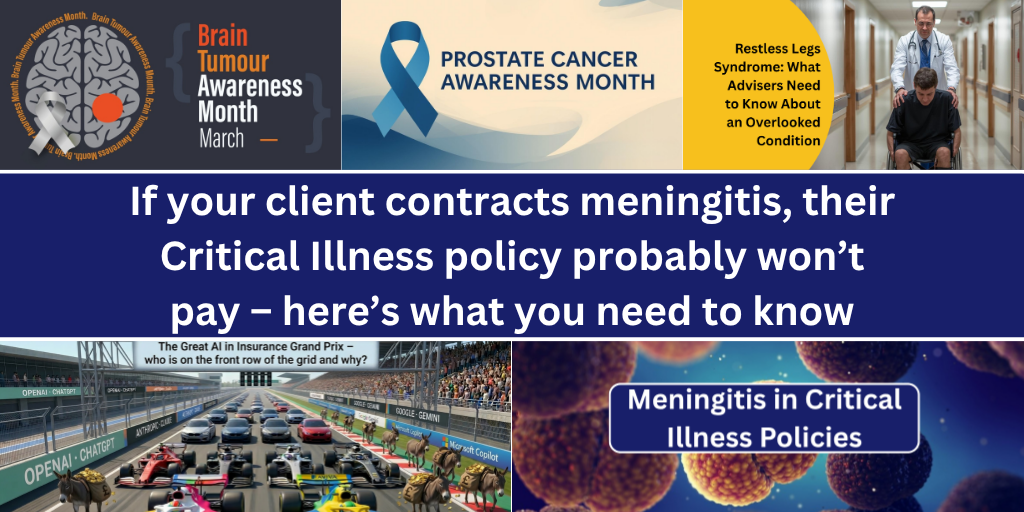
Most clients who contract meningitis will not receive a Critical Illness (CI) payment, and the Kent outbreak that has killed two young people this month has brought that reality directly in front of families who need to hear it clearly. That is just one of the gaps between what clients assume their protection covers and what it actually pays, that last week’s articles on Protection Guru address. Taken together, they make a powerful case for why a thorough understanding of policy definitions is not an optional extra in CI advice, it is the basis of the advice.
The Kent outbreak began in mid-March, centred on Canterbury, and was linked to meningococcal group B disease. By 23 March, UKHSA had confirmed 20 laboratory cases and two young people had died: a 21-year-old university student and a sixth-form pupil. The Health Secretary described the outbreak as unprecedented. Preventative antibiotics and a targeted MenB vaccination programme were offered to close contacts, including students at the University of Kent and sixth forms at affected schools.
For advisers, two points matter most. Viral meningitis, which is far more common than the bacterial form, does not trigger a CI payment. Coverage requires bacterial meningitis confirmed by a hospital specialist, alongside evidence of permanent neurological damage. Clients who have recovered fully may not qualify under the main meningitis definition in any policy, though some plans include a separate benefit for intensive care admissions that could apply where the episode was severe. The second point concerns vaccination. Most current university-age students were born before September 2015 and were not routinely vaccinated against MenB as infants. The Year 9 school vaccine covers strains A, C, W, and Y – but not B, which was responsible for the Kent cases. Private MenB vaccination exists but is currently in short supply across the country. These are the answers clients with teenage children and young adults are looking for right now.
I would urge you to read Meningitis in Critical Illness Policies in full. It covers the evidence claims teams require, how the permanence threshold in CI wordings reflects clinical reality, and what underwriting looks like for clients who have previously had bacterial meningitis.
Our analysis of prostate cancer cover published last Wednesday carries a crucial message both from a client outcomes and commercial perspective. The window for securing generous CI cover for this condition is narrowing, it is probably time to say to clients who don’t have or may have been delaying cover, take it out now while you can.
Prostate cancer is now the most commonly diagnosed cancer in the UK, with over 55,000 new cases each year. The diagnostic landscape is changing fast. MRI-based pathways are already more accurate than PSA testing alone, a liquid biopsy technology analysing over 100 biomarkers is showing early promise, and the TRANSFORM trial – the largest UK prostate cancer screening study in over 20 years – is under way with up to 300,000 expected participants.
Better screening means more early-stage diagnoses. For patients, that is unambiguously good. But for CI policyholders, the picture is more complex. All major UK insurers have already introduced lesser payments for early-stage prostate cancer, recognising that a diagnosis at this stage carries a very different prognosis from late-stage disease. As detection becomes more sensitive, the proportion of cancers caught at an early, highly treatable stage will continue to rise, and further refinement of tiered payment structures is a realistic prospect. Advisers who understand this trajectory can give clients a clear, practical message: buying CI cover now, before definitions tighten further, is prudent. Why New Tests for Prostate Cancer Mean Critical Illness Cover May Not Be So Generous in the Future sets out the clinical and commercial reasoning in full.
March is Brain Tumour Awareness Month. Brain tumours kill more children and adults under the age of 40 than any other cancer, yet historically just one per cent of national cancer research spending has been directed to this disease. To mark the month and support the work of Brain Tumour Research, our medical team reviewed benign brain tumour coverage across CI plans – and identified a coverage gap that will widen as treatment continues to evolve.
Meningiomas represent around 40 per cent of all primary brain tumours and the majority of benign cases. Radiotherapy for this condition is changing. Proton therapy is now available at NHS sites in Manchester and London. Stereotactic radiotherapy,– which delivers treatment over multiple sessions rather than in a single high-dose session, is increasingly used for smaller tumours. Both are distinct from stereotactic radiosurgery, which is the specific treatment some CI policies name when they refer to radiotherapy coverage for benign brain tumours. A policy that limits coverage to stereotactic radiosurgery will not respond when a client is treated with one of the newer modalities already in clinical use. That distinction will become more significant as MRI scanning identifies more meningiomas at smaller sizes, where radiotherapy rather than surgery is the appropriate first response. This is a classic situation where current policies have not kept pace with the latest available therapy.
If policy wordings require out of date treatments to trigger a pay out there is a very real risk that a consumer may have to choose between taking a less effective form of therapy which when their policy will pay out, or having the best treatment but not getting their claim paid. Clearly this would be a very poor customer outcome, and it is something that as an industry we need to address.
How Will Emerging Therapies Change the Way Benign Brain Tumours Are Covered in Critical Illness? also explains what underwriters will want to know when a client discloses a history of benign brain tumour, practical preparation for any application where this is relevant.
A quieter but significant development also appeared in Thursday’s articles. UnderwriteMe has extended its Protection Platform to include structured questions about restless legs syndrome. That is a signal that at least some insurers are beginning to ask more formal questions about a condition that most advisers have not previously needed to consider.
Restless legs syndrome affects between five and ten per cent of adults, yet clinical diagnosis rates are dramatically lower than that. Many sufferers have never received a formal diagnosis, even where their symptoms are clinically significant. If a client discloses what sounds like restless legs syndrome, an uncomfortable urge to move the legs, worse at rest and in the evening, relieved by movement, correct and complete disclosure from the outset is essential. The underwriting outcome depends on severity, underlying cause, and the treatment in place.
The medications used to treat restless legs syndrome deserve particular attention at the application stage. Gabapentinoids – gabapentin and pregabalin – are now the first-line treatment following updated guidance published in 2025, but they are also prescribed for epilepsy, neuropathic pain, and anxiety. An automated underwriting system may flag them for a reason unrelated to the client’s actual condition. A brief covering note confirming that the medication is prescribed for a diagnosed sleep-related condition can prevent unnecessary queries and avoid delays. Income Protection (IP) is the product line where restless legs syndrome has the greatest potential to affect the underwriting outcome significantly. In more severe cases, an exclusion or a decline is a realistic possibility. Restless Legs Syndrome: What Advisers Need to Know About an Overlooked Condition covers the full underwriting picture across life, CI, and IP, with specific guidance on preparing applications effectively.
The most forward-looking piece of the week sits apart from the clinical themes but connects to them directly. On 18 March, Aviva extended its AI summarisation tool to CI underwriting. I spoke with Robert Morrison, Aviva’s Chief Underwriter, to find out how the system has performed since it went live for life insurance in November 2025.
The results are significant. Since November, Aviva’s underwriting pipeline for life cases has reduced by around 75 per cent. Processing time for complex cases has halved. The tool compresses GP reports that previously averaged 78 to 80 pages down to around eight, so underwriters start from a focused summary rather than working through large volumes of clinical notes. Accuracy on CI cases is already above 99.4 per cent. Robert used a memorable analogy: landing an aircraft in zero visibility requires trusting your instruments. Aviva spent 18 months testing the system before deployment, which is precisely what makes that trust appropriate. IP is next, with discovery work beginning this month.
The distinction between generative AI – optimised for user satisfaction rather than accuracy – and purpose-built AI designed for regulated decision-making is an important one, and Aviva has been rigorous about applying it. AI capability should now be a factor in any panel review, particularly where a small panel is being selected and faster, more accurate decisions on complex cases will make a real difference to clients. Why I Think Aviva’s AI Underwriting Tool Gives Them a Strategic Advantage in Protection is worth reading in full. I would encourage you to ask your provider contacts directly: what is live in their AI programme today, what is in testing, and what is planned?
We produce our Protection Guru Digital Directory as a comprehensive technical reference for advisers across all areas of protection. All four clinical conditions covered this week – meningitis, prostate cancer, benign brain tumours, and restless legs syndrome – are included, giving advisers a structured resource to draw on in client conversations and for their own continuing professional development. You can access the Directory at Protection Guru Digital Directory.
Three of this week’s articles focus directly on CI definitions – what is covered, what is not, and where the threshold between a payment and a refusal sits. That is precisely where Protection Guru Pro’s condition-by-condition comparison capability is most useful. If you want to understand how different insurers define and cover benign brain tumours, early-stage prostate cancer, or meningitis resulting in permanent neurological damage, PG Pro allows you to compare wordings systematically, drawing on the medical expertise of our independent doctor panel. To help advisers make the most of the platform, we have published a library of short training videos. This week I would particularly recommend Comparing Modern CI Plans Effectively – a detailed walkthrough of how to run a condition-by-condition CI comparison in PG Pro, from filtering results to generating a compliance record that supports a well-evidenced recommendation.
This raises an important question. When helping your clients choose a plan to protect their income or the people they care about the most, do you just want to present the cheapest plan, or should you compare the most comprehensive cover and something in the middle that may offer the best value, with a condition-by-condition breakdown? If so, you may want to upgrade your protection proposition to Protection Guru Pro. Typically 85% of clients, given the choice between the cheapest plan and a better one, go for something better. After all, they are buying cover to protect the people they care about the most.
Advisers using our system regularly find they increase their written premiums, and therefore their commission, by 20% per month. If that sounds worthwhile, next time you need to give protection advice please click the button below to get a 7-day free trial of Protection Guru Pro. Please wait until you have a case you want to test our system with.
If you are part of a firm with 10 or more advisers, please complete our Corporate Licence Enquiry Form so we can explain how we can grow your protection income and tell you more about our Enterprise arrangements for larger firms.