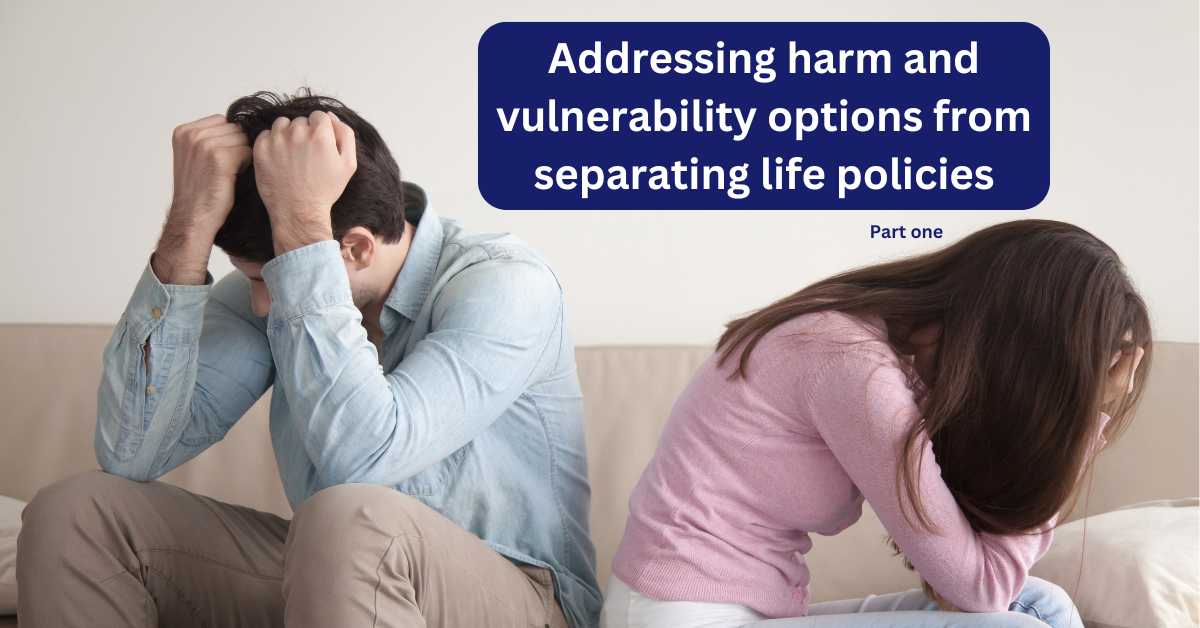
Addressing harm and vulnerability options from separating life policies – Forum recap part 1
For the first part of our January Protection Forum, we brought together advisers and insurers to discuss:
‘Addressing harm and vulnerability options from separating life policies’
Understanding how financial products can impact vulnerable individuals is critical, especially in situations of economic abuse. At a recent forum, experts and industry leaders came together to discuss the challenges and solutions surrounding life insurance policies, particularly joint policies, in the context of harm and vulnerability.
Ian Lomax from ‘Surviving Economic Abuse’ shared powerful insights into how life insurance can be misused as a tool for control, intimidation, and coercion. He highlighted the need for increased awareness among advisers and insurers to safeguard survivors of economic abuse by creating safer, more supportive financial environments.
Matthew Connell from the ‘Chartered Insurance Institute’ emphasised the importance of enabling financial independence through better policy design and professional advice. He explained how single life policies and flexible trust arrangements can mitigate risks and ensure clients are better protected from harm.
This page delves into the key themes of the forum, offering actionable insights for advisers, insurers, and industry stakeholders to improve outcomes for vulnerable clients and align with best practices under the Consumer Duty…
“With economic abuse there is that extra element of control. Any element of the product or the relationship which allows the abuser to retain some kind of hold over or knowledge of the circumstances of the victim survivor really compounds the abuse.”
“Any relationship could become an abusive relationship. There’s no way people can predict that in advance.”
“It’s good for everyone to have that option open to move their finances onto an individual basis… this is yet another advantage of seeking professional advice.”
“Practitioners have highlighted challenges not just in life insurance but also with trusts, death-in-service benefits, and defined benefit pensions, where the potential for abuse exists.”
“The Consumer Duty for the first time has this concept of consumer support… not managing situations properly becomes a breach of regulation.”
“Elements like writing policies as single policies are not just about mitigating the risk of abuse, but also about enabling future financial independence for everyone.”
“Good practice for advisers includes understanding the broader context of financial vulnerability and promoting solutions that support independence and fairness.”
Click the audio playback below to listen to the full session.
Full session audio
“We put across the survivors’ stories of how joint insurance policies impact them negatively when they do take them out.”
“Economic abuse was identified as one of 12 key risks in life that can affect a woman’s financial security in the ‘Six Moments That Matter’ report.”
“Joint insurance products, including life insurance, are taken out in the context of creating fear, intimidation, and control.”
“Advisers should create a comfortable environment for disclosure and understand how life insurance can be used as a tool of abuse.”
“There are good arguments for why single life policies would be better, but advisers must consider the potential vulnerability of policies if client situations change.”
“Creating a safe space where clients feel comfortable disclosing abuse is a vital part of improving outcomes and reducing stigma.”
“Advisers should consider how products can unintentionally enable control or harm and work proactively to offer solutions that protect vulnerable clients.”