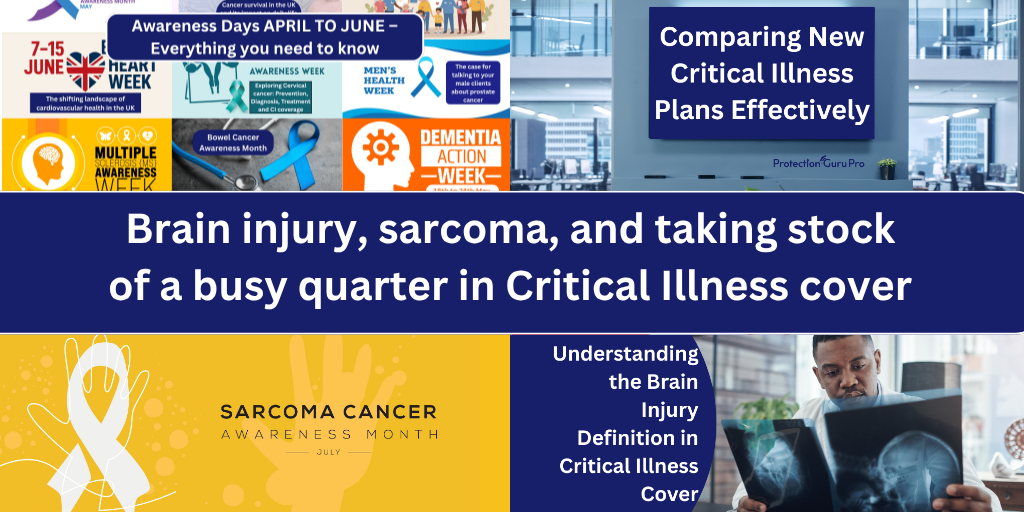
Last week’s articles on Protection Guru covered two of the more clinically detailed corners of Critical Illness (CI) cover, together with a quarterly review of everything we have looked at since April and a demonstration of how Protection Guru Pro handles a new CI comparison. Brain injury and sarcoma are the two clinical pieces to focus on. Both matter to the small number of clients who face these diagnoses, and to the many more who need advisers with real command of the detail behind their policy.
In Understanding the Brain Injury Definition in Critical Illness Cover, we get a close look at one of the broader but stricter wordings in a modern policy. Historically insurers have carried two separate headings, one for traumatic brain injury and one for hypoxic brain injury from lack of oxygen. A road accident can cause both a head injury and a cardiac arrest. Some insurers have now moved to a single combined wording, covering serious acquired brain injury however it happened, with the permanence test unchanged. The advantage is that mixed-cause events no longer need debate at claim about which category to sit in. Vitality’s Serious Illness Cover takes a different route, grading traumatic brain injury across four severity tiers from 25% to full payment and paying anoxic and hypoxic brain injury at Category D. Children’s wording carries its own detail worth watching. Survival periods and minimum-age clauses can quietly exclude neonatal cases from cover, which matters because birth asphyxia is a leading cause of permanent childhood disability.
In Exploring Sarcoma: Diagnosis, Treatment and Critical Illness Coverage, timed for Sarcoma Awareness Month, we get a useful reminder that CI cancer wordings extend well beyond the cancers clients hear about most often. Around 5,900 people in the UK are diagnosed with a sarcoma each year, about 16 a day. Sarcomas develop in connective tissue rather than organs or glands, which is why they present differently to the more common carcinomas. All malignant sarcomas, other than certain superficial skin types, meet the standard CI cancer definition. That is a useful conversation for a client who has heard the word and immediately assumed their cover does not respond. Underwriting a history of sarcoma is a different matter. Insurers assess each case on its merits, with postponement common during treatment, life cover with a reducing loading possible after a few years clear, and a cancer exclusion on new CI cover the most common outcome. Ten or more years clear can occasionally bring ordinary terms. The article also flags that gastrointestinal stromal tumours are a specific sarcoma subtype with their own wording position, to be covered in a follow-up piece this week.
The week also included the Awareness Days April to June quarterly review, pulling together everything we have covered across Q2 into a single reference document. For advisers who want a quick way to see how CI cover interacts with the awareness weeks their clients will have seen in the news, it is a useful landing page to bookmark. The final piece of the week, Comparing New Critical Illness Plans Effectively, is a short demonstration of how Protection Guru Pro handles a new CI comparison, from selecting cover type and term through to using quality scores alongside premiums. If you have not looked at the system in a while, or you have new advisers on your team who have not yet seen it, that video is worth ten minutes.
There is a thread running through the four pieces. The brain injury and sarcoma articles are close examinations of individual wordings. The awareness roundup and the Pro demonstration are the tools an adviser uses to keep track of the wider picture and to compare policies systematically. Detailed clinical understanding and detailed comparison tools work together. Neither is a substitute for the other, and both matter when a client is making a decision that will sit on their file for the next twenty or thirty years.
The point worth holding on to is that command of the detail on individual wordings is only useful when it feeds a structured comparison at recommendation. Fortunately, Protection Guru covers both sides of that. Make sure you read all the above articles in full using the links above.
We produce our Protection Guru Digital Directory as the ultimate protection technical guide for advisers, tying every awareness day and clinical condition back to the policy realities.
Whichever way your client’s situation reads, the practical question is the same. Which policy pays most for the conditions your client is most likely to face, and on what evidence?
Next time you need to give protection advice please click the button below to get a 7-day free trial of Protection Guru Pro. Please wait until you have a case you want to test our system with.
If you are part of a firm with 10 or more advisers, please complete our Corporate Licence Enquiry Form so we can explain how we can grow your protection income and tell you more about our Enterprise arrangements for larger firms.