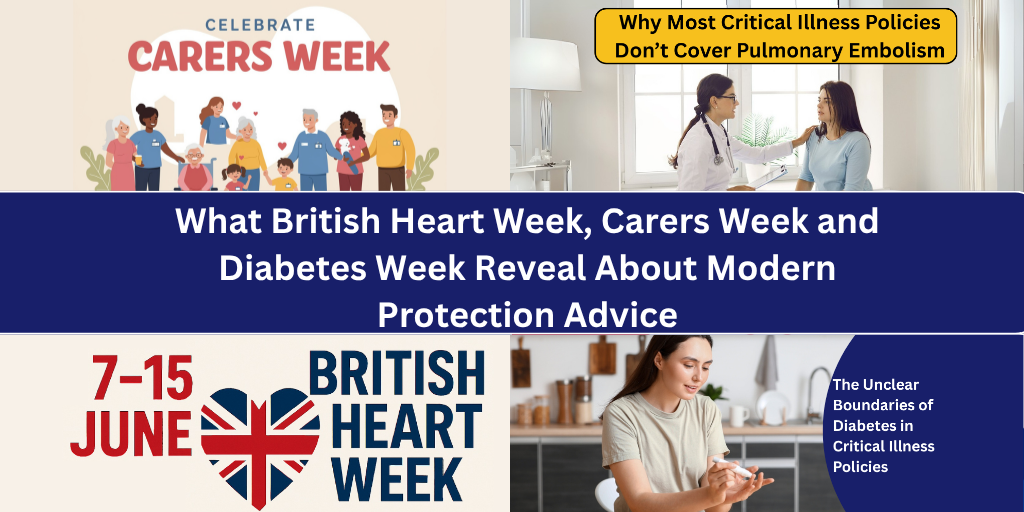
British Heart Week, Carers Week and Diabetes Week all ran concurrently last week. Last week’s articles on Protection Guru picked up each in turn. A fourth piece looked at pulmonary embolism, a condition that most clients will assume is covered when it usually is not. Together the four pieces map onto the questions that come up most often in fact-finds and at recommendation.
In The shifting landscape of cardiovascular health in the UK, timed for British Heart Week, we get the underwriting picture as it actually is in 2026. Cardiovascular disease still affects around 7.6 million people in the UK and accounts for roughly one in four deaths under 75. Smoking rates among under-30s have fallen to a generational low. The bigger story is GLP-1 weight loss medication. Patients on semaglutide and tirzepatide are losing 10 to 20% of body weight, with blood pressure, cholesterol and HbA1c falling alongside. Insurers are responding in different ways. Some accept the current metabolic markers at face value. Others want twelve to twenty-four months of sustained loss before they will move a client out of an obesity loading. For an adviser with a client on a GLP-1 drug, the timing of the application is now a real conversation.
In The cost of being a carer, timed for Carers Week, the editorial point sits on the other side of the application form. Carers UK estimates 5.8 million unpaid carers in the UK, providing care worth around £162 billion a year. Carer’s Allowance pays £86.45 a week, with entitlement lost above a low earnings threshold. Around 43% of carers providing 35 hours a week or more are in poverty, more than double the rate for non-carers. The cover that does the most work in a caring household is Income Protection (IP) on the working partner. If that income is interrupted, the household loses earnings and the ability to share caring at the same time. Many clients who are carers do not raise it at fact-find unless asked. The simplest thing an adviser can do this Carers Week is ask the question.
In Why Most Critical Illness Policies Don’t Cover Pulmonary Embolism, the editorial point is the gap. A pulmonary embolism is a blood clot lodged in the blood vessels of the lung. Around 36,000 people are admitted to hospital with one in England each year. Hospital mortality has fallen from around 10% to closer to 1% over thirty years, on the back of CT pulmonary angiography and earlier anticoagulation. Standard Critical Illness (CI) policies do not engage with the condition at all. A resolved PE that has been treated with anticoagulation will not trigger any specific claim. The claim only lands when the case is severe enough to engage another wording: cancer, cardiac arrest, intensive care, coma, or pulmonary hypertension where chronic disease develops after recovery. Vitality’s Serious Illness Cover is the single exception, paying 15% of the cover amount on diagnosis. For most clients on most policies, this is a silent condition.
In The Unclear Boundaries of Diabetes in Critical Illness Policies, timed for Diabetes Week, we get the clearest example of wording lagging behind the medicine. The standard CI policy pays an additional benefit for Type 1 diabetes that requires permanent insulin therapy. LADA, latent autoimmune diabetes in adults, is autoimmune like Type 1 but presents in adulthood and is frequently misdiagnosed as Type 2 in its early years. Around 5 to 10% of adults labelled Type 2 actually have LADA when tested. Some insurers exclude it explicitly. Others remain silent and leave the question for claims. Modern Type 1 care is also moving from injections towards pumps and hybrid closed-loop systems, and some older wordings still refer to insulin injections specifically. Payment levels on the policies that do cover Type 1 vary widely, from 15% with no cap on Vitality to 100% capped at £35,000 on Legal & General.
There is a straight line across all four pieces. The conversation that decides whether a client’s cover does the job is rarely about a single condition. It is about the underwriting timing on a new medication, the household structure the cover is built around, the rare diagnosis the wording does not engage with at all, and the everyday condition the wording was written for two decades ago. In each case, the work the adviser does between fact-find and recommendation is what makes the difference.
CI and IP do not solve every problem. They are tools that work when they are matched to the client in front of you. Fortunately, Protection Guru exists to give you the detail to make that match precise. Make sure you read all the above articles in full using the links above.
We produce our Protection Guru Digital Directory as the ultimate protection technical guide for advisers, tying every awareness day and clinical condition back to the policy realities.
Whichever side of the fact-find your client’s situation sits on, the practical question is the same. Which insurer’s wording, underwriting and added value services line up best with the client’s real life, and on what evidence? If you have not yet seen how Protection Guru Pro handles that comparison in practice, the Critical Illness – new policies demo is a useful starting point. It is the difference between selling cover and recommending the right one.
Do you want to present your clients with a thorough analysis that shows them the cheapest plan, the most comprehensive cover and something in the middle that may offer the best value, with a condition-by-condition breakdown? If so, you may want to upgrade your protection proposition to Protection Guru Pro. Typically 85% of clients, given the choice between the cheapest plan and a better one, go for something better. After all, they are buying cover to protect the people they care about the most.
Advisers using our system regularly find they increase their written premiums, and therefore their commission, by 20% per month. If that sounds worthwhile, next time you need to give protection advice please click the button below to get a 7-day free trial of Protection Guru Pro. Please wait until you have a case you want to test our system with.
If you are part of a firm with 10 or more advisers, please complete our Corporate Licence Enquiry Form so we can explain how we can grow your protection income and tell you more about our Enterprise arrangements for larger firms.