Many advisers and many clients read a Critical Illness (CI) wording and assume it does what the name suggests. Last week’s articles on Protection Guru looked at three different misconceptions about where CI cover actually pays, and where it does not.
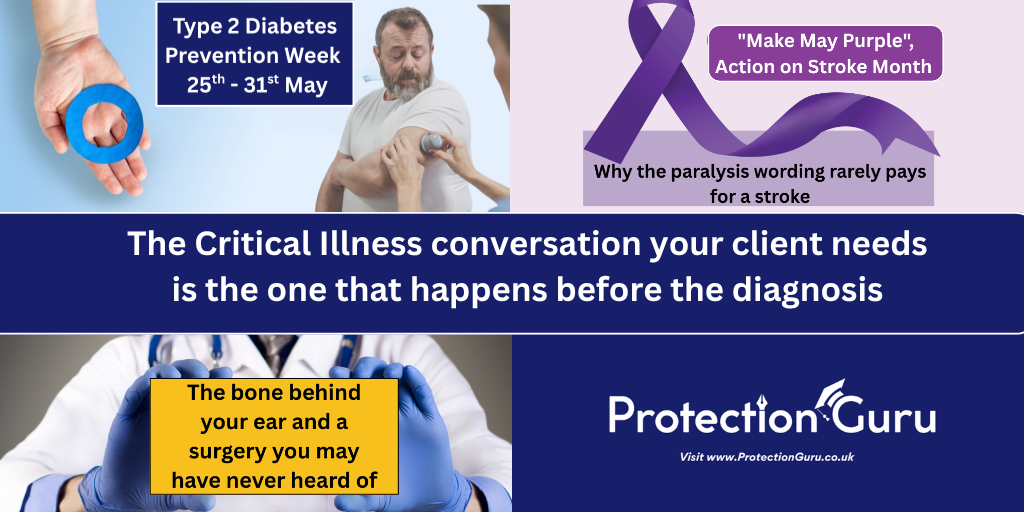
In Type 2 Diabetes: The Diagnosis Every Adviser Sees, timed for Type 2 Diabetes Prevention Week, we get the underwriting reality. Around 5 million people in the UK live with diabetes, and roughly one in five UK adults is in that group or sitting on raised blood sugars at high risk. The misconception is that the diabetes conversation starts at diagnosis. From an insurance angle, by then it is largely over. CI and Income Protection (IP) applications are commonly declined once Type 2 is on the record. Life cover usually remains available, particularly with good control, but the broader protection conversation has narrowed. The conversation that matters is the one held with clients in their 30s and 40s who are statistically heading towards prediabetes, while full cover is still on the table.
In The bone behind your ear and a surgery you may have never heard of, the misconception is at the other end of the scale. Most advisers have never heard of a radical mastoidectomy and would not expect it on a CI policy. Around 185 radical procedures and just over a thousand modified radical procedures are performed in England every year, most often for cholesteatoma or for chronic mastoid infection that has eroded bone. Vitality is the only UK insurer with a named clause for the procedure, paying 10% of cover under its Serious Illness Cover. The hearing loss wording on most policies will not pay on single-sided loss, and the meningitis wording only catches the rare case where infection spreads to the brain. The pre-operative situation, where disease is destroying bone but has not yet spread further, is the gap Vitality’s clause is designed to close.
In Why the paralysis wording rarely pays for a stroke, the most common misconception of all is corrected. Around 100,000 people in the UK have a stroke each year and three-quarters leave hospital with some weakness on one side. The natural assumption is that the paralysis of limbs clause sits as a safety net for the most serious stroke outcomes. It does not. A stroke serious enough to permanently paralyse a limb is, by definition, a large stroke that will satisfy the stroke wording itself, and that wording pays first. The paralysis clause is there for the smaller but life-changing population of clients who suffer a traumatic spinal cord injury. Around 2,500 new cases occur in the UK each year, most often from falls (now the commonest cause, overtaking road traffic) or from contact sport. The 2022 Association of British Insurers (ABI) review widened the trigger from two limbs to any one limb, catching cases the old wording would have missed.
There is a straight line across all three pieces. The wording does not always do what its name suggests. A diabetes underwriting question that has already closed by the time most clients ask about cover. A radical mastoidectomy clause that almost no adviser knows is there. A paralysis clause that pays for spinal cord injury, not stroke. The adviser who reads the wording for what it actually covers is the adviser whose recommendations hold up at claim.
The tension advisers are holding is obvious. Clients buy CI cover on the names of the clauses. The clauses pay on what the wording actually says. Fortunately, Protection Guru exists to give you exactly that detail. Make sure you read all the above articles in full using the links above.
We produce our Protection Guru Digital Directory as the ultimate protection technical guide for advisers, tying every awareness day and clinical condition back to the policy realities.
The practical question for your client’s case is the same. Which insurer’s wording pays in the situations your client will actually face, and on what evidence? If you have not yet seen how Protection Guru Pro handles that in practice, the Critical Illness – new policies demo is a useful starting point. It is the difference between selling cover and recommending the right one.
Do you want to present your clients with a thorough analysis that shows them the cheapest plan, the most comprehensive cover and something in the middle that may offer the best value, with a condition-by-condition breakdown? If so, you may want to upgrade your protection proposition to Protection Guru Pro. Typically 85% of clients, given the choice between the cheapest plan and a better one, go for something better. After all, they are buying cover to protect the people they care about the most.
Advisers using our system regularly find they increase their written premiums, and therefore their commission, by 20% per month. If that sounds worthwhile, next time you need to give protection advice please click the button below to get a 7-day free trial of Protection Guru Pro. Please wait until you have a case you want to test our system with.
If you are part of a firm with 10 or more advisers, please complete our Corporate Licence Enquiry Form so we can explain how we can grow your protection income and tell you more about our Enterprise arrangements for larger firms.