Should all insurers issue annual statements on all plans?
The latest forum hosted by Protection Guru brought together industry experts and professionals to delve into the crucial role of annual statements. As advisers exchanged ideas and shared insights, the discourse illuminated the pressing need for transparency, accountability, and enhanced communication between insurers, advisers and policyholders. In this transcription of the thought-provoking discussions, we explore the arguments, perspectives, and solutions proposed by these knowledgeable individuals, shedding light on why annual statements and further action from insurers are imperative in today’s protection landscape.
Specifically, we heard from…
- Ian Sawyer – Assured Futures
- Adam Kaplan – Pendragon Protect
- Emma Astley – CoverMy Bubble
- Jack Southcott – The Exeter
Before the session, we asked advisers…
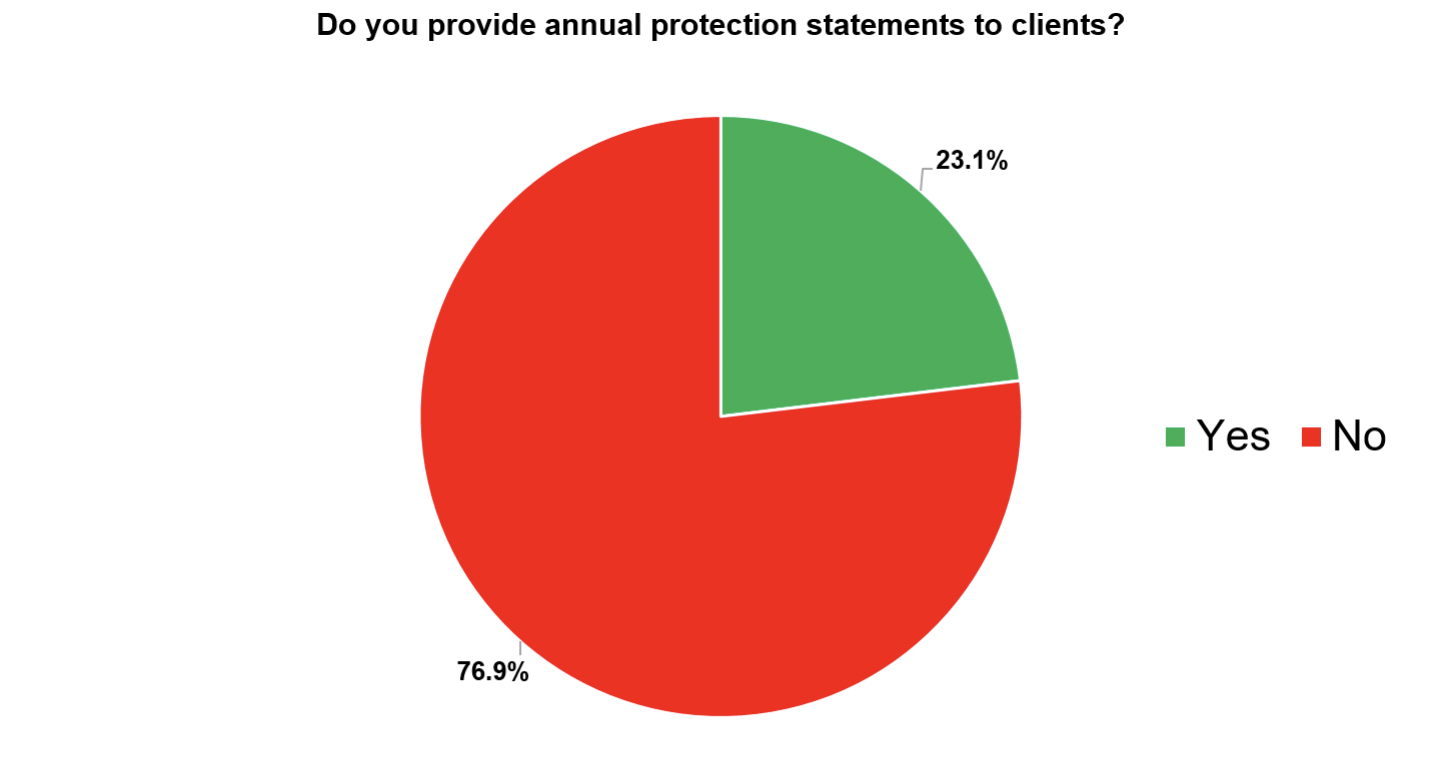
“Insurers hold the key here. And you’ll see that for life annual statements, 50% do an annual statement and 50% do not. Some only do it for indexation cases. And what I find really quite shocking is a lot of them only send out an annual statement if it’s indexed. Which, you know, the combination of those two things I find relatively shocking. In my opinion, annual statements are a necessity. They’re a great opportunity to drive the right sort of behaviours and the right sort of consumer education that people need in remembering what they have and how to review it. And it’s also a great opportunity to promote the value-added services, the aspects of the policies, all those things. So it’s a really multifaceted opportunity in my point of view.”
“Overall, my call is that the insurers should be supplying intermediaries with the information so that they can do their own annual reviews. And that should be a matter of course because then it’s up to the intermediary to do and personalise their own literature. I think insurers have a responsibility regardless of what the intermediary is doing, to send out an annual statement to remind customers of what they have, and what they haven’t got, provoke them to think about what their needs are now currently and take advantage of giving them good information and good consumer duty outcomes”
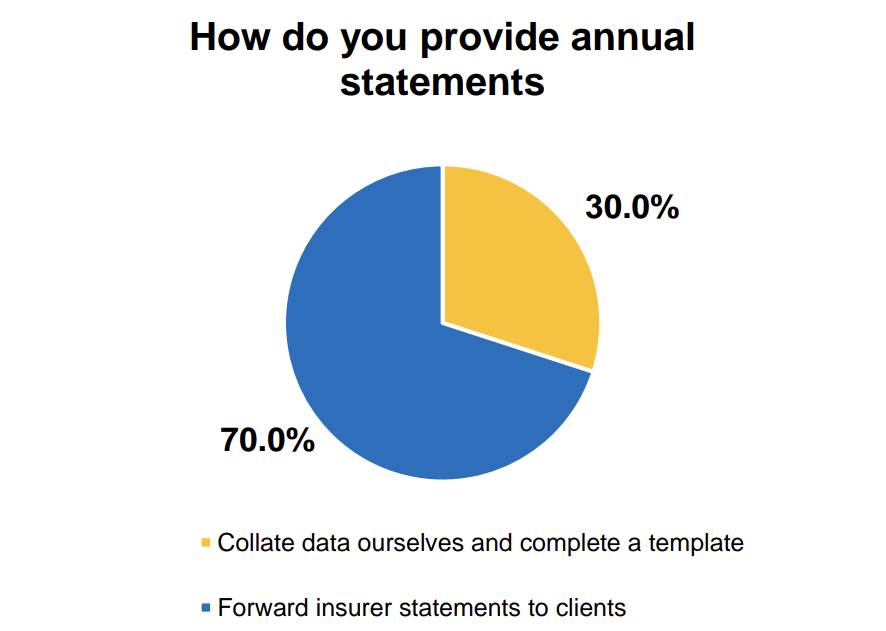
Of those who provide annual statements, we asked…
Full session audio
Part 2:
“Annual statements, are to me, so important. And we’ve been doing this now for over five years at Cover My Bubble. So keeping our clients updated and continuing that customer journey is very important to me. To me, we must be there for the client’s full journey. People forget what they’re covered for. They haven’t got a clue. The circumstances change. So that’s why, as advisors, we have to be in contact with them, reminding them what cover they have. We emailed the insurers manually to actually get updates. So yes, that can be a faff sometimes, but it’s important to get the figures right so we can advise our clients what they’re covered for.”
“We then send out a statement. So this is our own bubble statement. It’s simple. It’s easy to read. It breaks everything down for the clients to let them know what they’re covered for and what they currently have in place. We also explain about children’s cover, and also the added benefits. That’s something that we’re always reminding our clients on and we’ll resend links and videos that we’ve made on social media of how to use these services and book an appointment. I think Aviva and Exeter are good at reminding us of the amounts and what cover it is, and it’s great if all the insurers can move over to this just to make it a little bit easier for us.”
“To me, it’s our job to update our clients. Yes, we have been paid for it. We’ve been paid for it from the beginning when we received the commission. And that money is there for the full client journey, not just for a quick sale and to move on to something else. And we don’t just forward the insurer certificates. No offence guys, but they can be quite clunky. Too much information and we’ve heard back from our clients that they might just bop it behind a kettle or the toaster and it stays there, they don’t look at it. At least with our statements, they can see everything. It’s very visual, very pleasing, and the feedback that we’ve had from clients is, is quite good and why we keep doing it.”
“We ask our clients for feedback all the time and they come back to us to say, ‘Yes, Emma, this is great. This is what we need because we do need reminding. Our circumstances do change. Engaging with your clients after the sale is so important.”
“We’re very big believers in following our clients’ journey. So we’ll email our clients one month, three months, six months, and nine months, fun, engaging educational information. But we also give that information on social media so they can see, ‘Oh, actually I’ve got that on my policy”, “Oh, I need to make a claim”, but it’s keeping that engagement going with clients. So by staying in contact with them and sending these annual statements, we’re making sure our client’s policy is up to date and it’s for their current circumstances.”
“If we take, in my opinion, the two best insurers for anniversary statements, which are Vitality and The Exeter. they send an email, you download the anniversary statement, we attach it to the template email we’ve got, and the template email we use is all about the added value services like health-wise, for example, or with vitality, reminding them of the partners and rewards. But the most important part about email is that we say ‘If your circumstances have changed in the last 12 months, please let us know so that we can make sure your cover is still suitable’. And then it says, for example, ‘if you’ve moved house, you’ve remortgaged, you’ve had a child, your marital status has changed’. Last year we had eight marital splits. Some amicable, some not so much. As Emma said, if you change your jobs, if you’ve had a pay increase, there are so many scenarios where you need to review your cover. And because the majority of our business over the last 18 months, two years has been income protection, it’s been a fab way to open the door for conversations for us.”
“I think the most important thing about anniversary statements for me is that over the last three and a half years, 17.5% of our business has come off the back of those. Now, sadly, not all insurers do them, or if they do, they don’t do them so well. In my opinion, the best two are Vitality and the Exeter, and I’ve seen improvements with British Friendly.”
“For me, the biggest thing about these anniversary statements is if their circumstances change, get in touch with us because we physically don’t have the manpower to ring every single client we’ve got every single year. We’re not a big call centre. We do not have the manpower to do anniversary calls, let’s say. But what does help massively is those anniversary statements are again, I’ll go back to vitality, but it’s friendly and the Exeter is a two-minute job to download the statement. They typically come in overnight in the morning between 8 and 9. When I’m catching up with emails, just download them or save them sort of file once a month. My PA goes in, takes her half an hour, sends them all out, and then we’ll get a handful of responses, reviews booked in some turn into a business. Some don’t. But the most important thing is that the clients that don’t respond are retained for life, if that makes sense.”
“One of the things that our annual statements do is give “that then and that now” comparisons, which I think is really important. So we do them for both income protection and life in all circumstances. I think the then and now comparison is really important for members on age-costed premiums obviously because they want to know what they were paying and what they’re going to be paying for the year ahead. Adam made a really good point as well about indexation because with inflation rising, there’s a risk that benefits and premiums are going up, but client salaries aren’t increasing at the same speed to be able to support a full payment claim. So all insurers have different arrangements there. But with our policy, indexation can be refused each year, which I think is really good support in the cost of living crisis at the moment. So the statements themselves will say, if you don’t want your benefit and premiums to increase in line with RPI this year, let your adviser know and let us know.”
“I think it’s really important that the statements are also positioning clients and signposting clients back to their adviser. We also do that for any changes in circumstances and something that we also try and hammer home is the point around circumstances changing with your earnings because, you know, one of the big issues we know with income protection specifically is around over insurance and not being able to evidence 12 months of income prior to claim. So we try and reinforce that wherever, wherever we can, because I don’t think that can be said enough times, so annual statements are just another good place to do that.”
Protection Guru Pro:
“Consumer duty is coming up pretty quickly. And as many of you will know, we do have a system that we hope can help advisors, particularly around demonstrating value to clients with regard to protection recommendations. That system is called Protection Guru Pro. There are free trials available if you would like to go on and have a little play with the system. But ultimately what we’re trying to help advisors do is to compare products based on the quality of the product, based on your client’s needs and price side by side. And we work with iPipeline in order to pull through pricing into the system. Protection Guru Pro enables you to compare not just critical illness, we do a comparison of historical-critical illness plans. So if you do have a client that has a critical illness plan already, you can compare their current critical illness plan to two new plans in the market to see if you can put them in a better position. But it also does income protection, family income benefit, business protection.”
“We do use doctors to assess the critical illness coverage, and every single analysis that’s run through our system is unique to your client based on their particular chances of suffering from the conditions that are covered.” – Adam Higgs, Protection Guru
To find out more about how ProtectionGuruPro works, and how it can help you get ‘Consumer duty ready’, click below…