The is the first of our output content from our recent October Protection Forum, where we brought together advisers and insurers to discuss “How do advisers and insurers manage policy cancellations and lapses?”.
We heard from a panel of expert speakers, of both advisers and insurers to share their views on the subject, including Robyn Allen of Robyn Allen Solutions and David Mead of FutureProof.
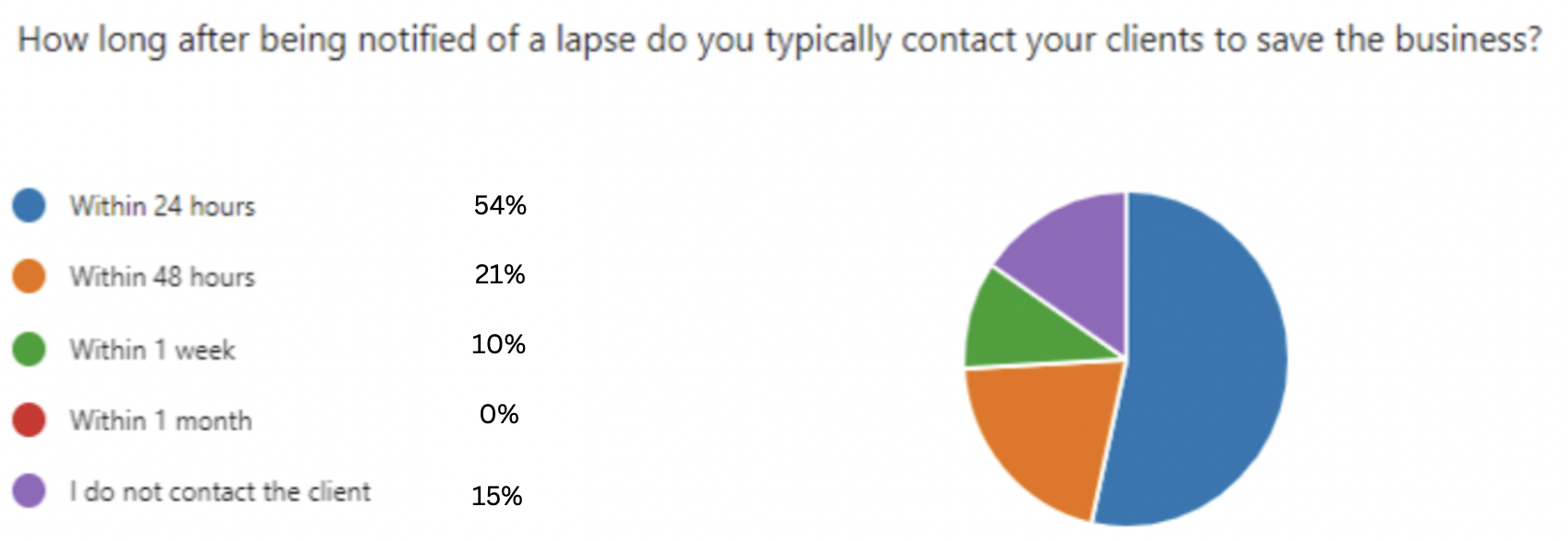
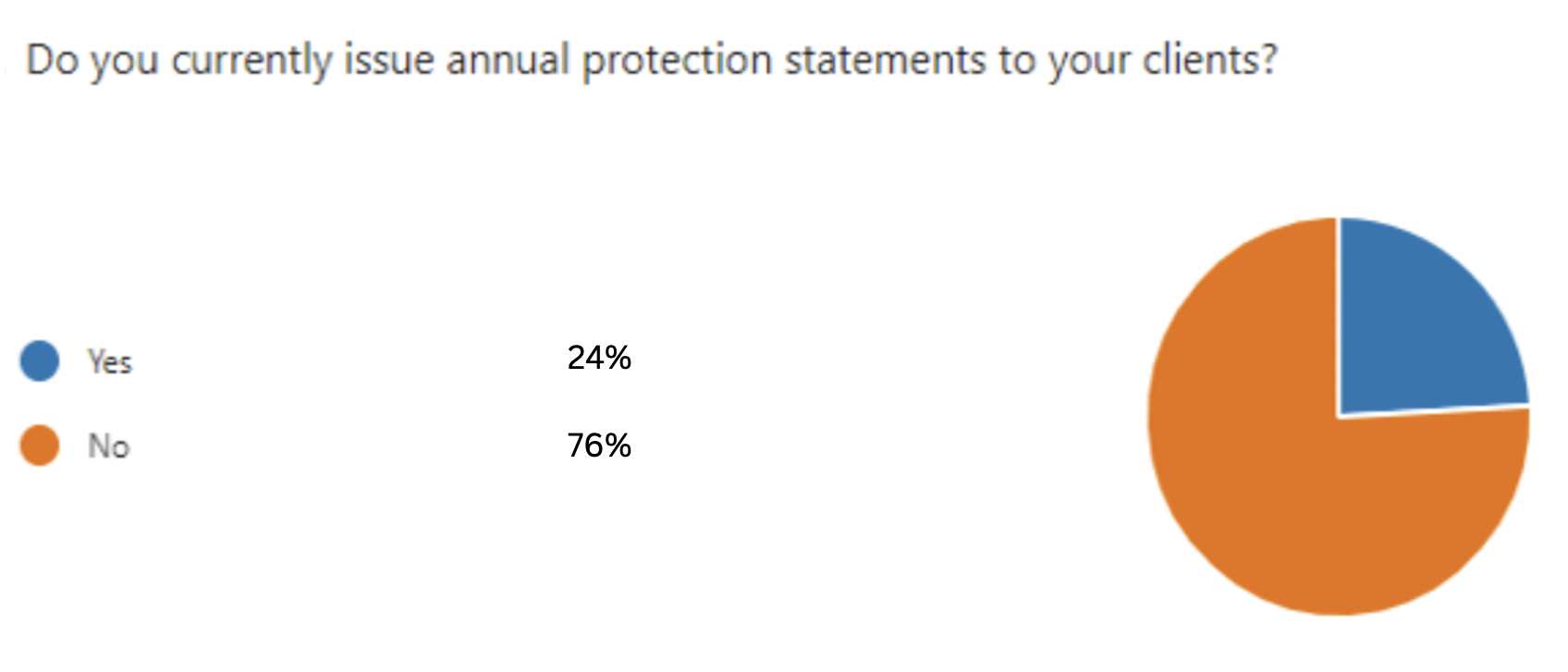
We also asked a number of ‘pre-session surveys’ to get advisers perspectives, which can be found below throughout this page.
We focused on:
- Do insurers do enough to warn advisers of missed payments or cancellations?
- What early warning processes do insurers currently have in place? Are these working?
- How do advisers get on the front foot when they suspect a client might cancel their policy? Can more be done to pre-empt cancellations by regularly engaging with clients?
- How can data be used as a method of early warning? Are there certain demographics of clients more likely to cancel?
- What process do advisers follow when they are notified of a cancellation? What can other advisers learn from this?
“So in terms of lapses and cancellations over the last 12 months, I’ve maybe seen a handful and that is it. I haven’t seen a big uptick because a lot of it I think gets hyped up. We’re going to see costs of living rising, we assume people don’t think their insurance is important, so they are going to cancel it, which isn’t always the case.
I think the conversations and understanding of your clients own financial risks is more important than ever. If they’re on a tight budget and you’re writing a premium that is taking something from that budget, understand the risks that could arise for that client. If they rely heavily on overtime. What would happen if your overtime went away? Would that put you into a negative at the end of every month? Make sure you’ve had those conversations so that when you see that email pop up, if they’ve missed a premium, you know what the situation could be. Because the better we know our clients, the more we can help and the more we can intervene and help before it even happens.”
Full session audio
As well as discussing how best to manage notifications of lapses or cancellations, a big focus for the discussion was around the important of mitigating cancellations in the first place through regular client engagement. This could include everything from annual statements and reviews each year, to the process of engagement following the onboarding of that client. David Mead from FutureProof shared his perspective, managing a leading protection advice firm and the efforts they go to in ensuring they maintain regular contact with the client throughout the life-time of the policy.
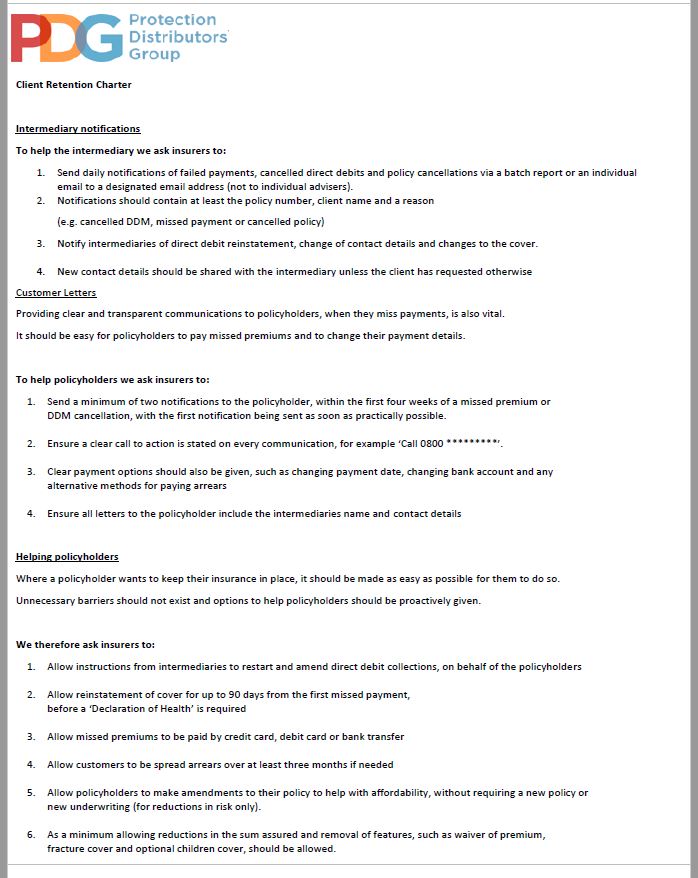
David also shared with us a copy of the Protection Distributers Group Client Retention Charter, which you can download by clicking the image below:
“Prevention is better than the cure. 80% of our firm’s efforts go into preventing potential lapses and maybe 20% of our resources are applied to the problem if a notification [of missed direct debit or cancellation] comes along.
Retention isn’t really just something you do when you get a notification from a provider though, it’s really about philosophy for me and it really should be part of our culture. But my challenge to many, including providers here, is what other industry wins the client by way of huge amount of marketing and sales activity and then you on board the client. Over a relationship that could last decades and then effectively ignore them. It could well be the last time they [the client] ever hear from the person who either sold the policy or the provider who takes their direct debit every month. Quite frankly, I think we’re the masters of our own destiny. If that’s some people’s approaches and then we hear conversations about retention issues, well, it’s not really surprising.”
“You have to engage your clients, talk to them being contacted, engage them, and basically you won’t have a you won’t have as much problem as you might anticipate. It’s when we ignore people that are their issues. And also we’ve got, dare I say, a duty of care to keep in touch with people.”
“I think we’ve got a responsibility, guys, to talk to our clients about the cost of living crisis. What you’ll find is people just don’t know who to talk to. Full stop. And there’s lots of things that we can do as protection advisors to help people. Some real basic advice that you can give. And I think you’ll find a lot of your clients are looking around for help.”
We also heard from Mike Pritchard, Commercial Manager (Distribution Quality & Retention) at Legal & General, who has spoken previously on our forum about the work Legal & General do to support advisers around client retention.
“The one thing I do want to point out and the cost of living crisis is something that will hit some customers very hard. Some of you guys may not be dealing with the lowest in the socio economic demographic classes. Those are the ones that we think are the critical ones that potentially will have policies that could cancel in the near future. So from a legal and general point of view, we’re trying to not propensity model, but we’re trying to factor in where potentially there could be a greater hit for those firms that are actually fishing in the pond where there is a kind of lower socioeconomic group in there. So that’s not for everyone, but for those that do actually maybe, for instance, get their new business from social media or from lead generators, that’s where potentially kind of there’s a bigger hit.”
“Most of it is around relationship management. I think, as David’s pointed out, Robins pointed out and Ian’s pointed out as well, if you don’t have a relationship with your customer, guess what’s going to happen? The customer, the first time they get to a point where they’ve got some expenditure issues, they will look at that policy and that premium, that direct debit will be the first thing to cancel. And we see this time and time again. So there is a very, very strong correlation between those businesses that have got good relationships, good value add mutual value exchange relationships with customers and those that don’t.”
“I think it’s important that clients can visually see easily and quickly what they’re covered for. They don’t want to see a lot of jargon, which we do send out anyway in the normal all the normal documents. But what we wanted with this was just to make it quite visual and easy to know what they’re covered for quite quickly in in a language that they understand. There’s so many words that we throw around in the industry that clients just don’t understand unless they’ve been through the right process with an advisor who’s explained anything. So we keep in contact with our clients quite regularly. We’re always chatting with them and quite regularly around social media as well as sending out the emails, birthday text messages, you know, chasing for information that’s outstanding and things like that. So this helps so much.”